Lakeland Highlands, FL · Polk County
Dumpster Rental in Lakeland Highlands, FL
Roll-off containers delivered to Lakeland Highlands from our Lakeland yard — south of our Combee Road yard, below the Lakeland city limits off Lakeland Highlands Rd. Flat rates, driveway protection as standard, and same-day delivery when we can get a truck free.
Roll-off containers for Lakeland Highlands homes and jobsites
Lakeland Highlands is not a city. It is a census designated place in unincorporated Polk County, lying south of the Lakeland city limits and north of the Mulberry city limits, with a population of about 12,187 at the 2020 Census across roughly 5.64 square miles of land and 0.78 square miles of water. There is no Lakeland Highlands city hall, no mayor and no local permit desk, because there is no municipality. Polk County is the government here in every sense that touches a container, and that single fact answers most of what people call us about.
The confusion is understandable. The addresses say Lakeland, the schools say Lakeland, and the shopping is in Lakeland. But the rules are the county's, and the county's rules are different from the City's in ways that show up on the curb. The clearest test is the one the City of Lakeland publishes itself: if your cart is gray or black with a yellow lid, you are a Polk County customer, and the number to call is Polk County Solid Waste on 863-284-4319 rather than the City on 863-834-8773.
The biggest difference behind that cart is recycling. Inside the Lakeland city limits there is weekly automated curbside recycling. In unincorporated Polk County, curbside recycling has been discontinued entirely. Residents were told they could repurpose the old recycling cart for household or yard waste, or call the county to have it collected. Neighbors two miles apart genuinely have different answers, and it is not a mistake on anybody's part.
The second difference is bulky collection. Polk County collects furniture and appliances monthly on a set schedule, at no per-item charge, funded through an annual assessment rather than a per-pickup fee. What it will not take is the list that matters on a renovation: construction debris, whole trees, stumps, root systems, land-clearing material, vehicles, boats, tires, hazardous materials and biomedical waste. A kitchen tear-out or a fence replacement is squarely on that list, which is why a container ends up on the drive.
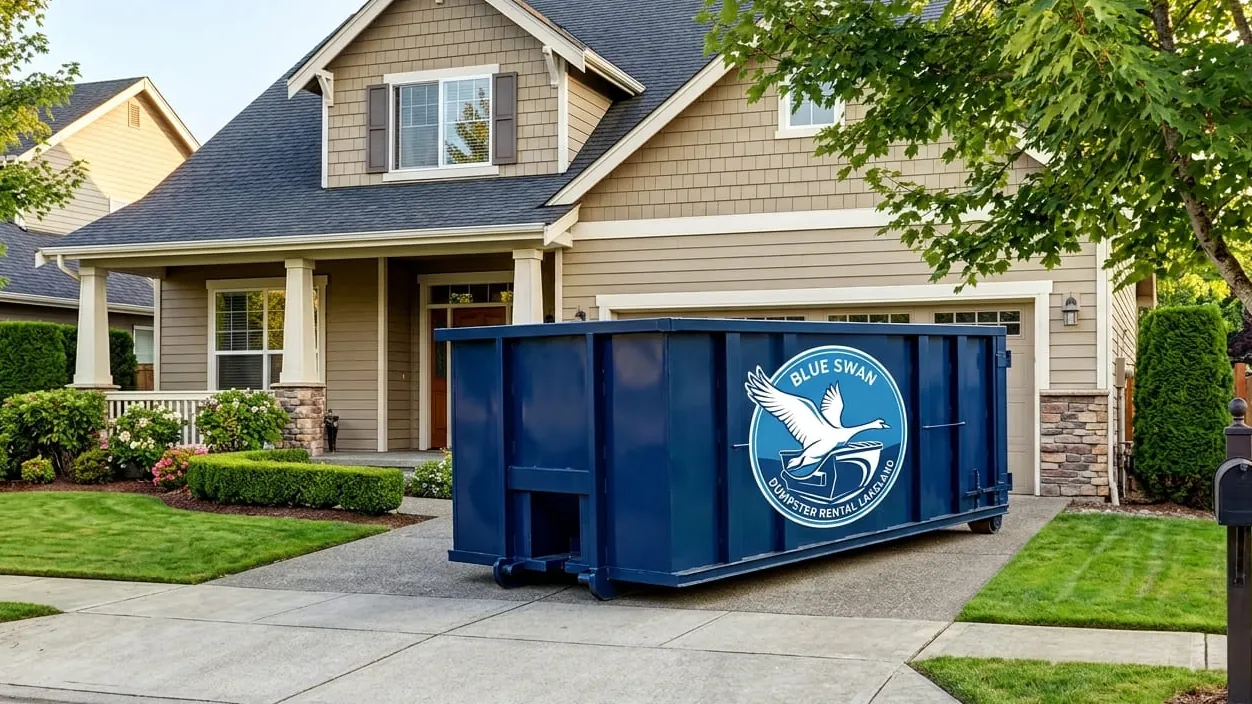
Lots out here are generous and the driveways are usually long, which makes this easy ground for a 20 or a 30. Call (863) 267-9087 and describe the approach.
What we know about working in Lakeland Highlands
There is no city permit desk here because there is no city. Lakeland Highlands is unincorporated Polk County. The City of Lakeland's Right-of-Way Use Permit, the one whose provisions name dumpsters and roll-off containers explicitly, applies to work within the City of Lakeland right of way, and that is not this. If any part of a container will sit in a public street or on a county road shoulder here, the authority is the county rather than a city, and Polk County Roads and Drainage is the desk to ask, at 3000 Sheffield Road in Winter Haven on (863) 535-2200. It maintains more than 2,750 centerline miles of county road. If your frontage is on a state road, US 98 and SR 540 among them, the right of way is the state's instead.
On your own driveway we are not aware of a Polk County permit requirement for a container placed entirely on private property. That is what we know rather than a guarantee, and it does not touch deed restrictions. A number of subdivisions out here are deed restricted, and HOA covenants are private recorded instruments rather than county ordinances, so the county will not enforce them and cannot look them up for you. Neither can we. Ask your board before you book if you have one, because a five minute call is cheaper than a violation letter.
Fire and rescue is Polk County Fire Rescue, from more than 45 stations, with administration at 1295 Brice Blvd in Bartow on (863) 519-7350. Building permits for unincorporated Polk come from the Polk County Building Division in Bartow on (863) 534-6080, whose own guidance is that a permit is required to construct, enlarge, alter, repair, move, demolish or change the occupancy of a building, and that demolition of any structure requires a permit regardless of size.
Disposal is the North Central Landfill at 7425 De Castro Rd in Winter Haven, published at $46 a ton for construction and demolition debris, $46 a ton for household waste and $36.50 a ton for yard trash with a $10 minimum, as published, and open solely to commercial haulers carrying materials from within Polk County.
- RegionPolk County
- Distance from our yardSouth of our Combee Road yard, below the Lakeland city limits off Lakeland Highlands Rd
- Main routesCombee Rd south to US 98, west into Lakeland, then south on Lakeland Highlands Rd
- Typical deliverySame or next day
Getting a truck to you
The run from the yard is Combee Rd south to US 98, west through the city, then south on Lakeland Highlands Rd, which is the spine of the community. SR 540, Winter Lake Rd, crosses the north end and is how we reach the eastern subdivisions, and the Polk Parkway, SR 570, cuts across the top of the area as a toll road with interchanges we use when the load justifies it. This is comfortable ground for a roll-off truck. Lots are larger than in the city, driveways are longer, and there is usually somewhere sensible to put a 30 without touching the street. What we watch is the tree canopy on the older streets and the drainage swales on the newer ones, because a swale that looks like lawn is a ditch with grass on it. A 20 yard box wants about sixty feet of straight approach, eleven feet of working width and better than twenty feet of clear overhead. Tell us where the swale runs and we will keep the wheels off it.
Routes we run: Combee Rd south to US 98, west into Lakeland, then south on Lakeland Highlands Rd, Lakeland Highlands Rd south from the city for the length of the community, SR 540, Winter Lake Rd, east and west across the north end, SR 570, the Polk Parkway, to the Lakeland Highlands or US 98 interchange, which is a toll road, US 98, Bartow Rd, south for anything on the eastern edge.
Landmarks and neighborhoods we work around
Local landmarks
- Lakeland Highlands Road running north to south
- the Polk Parkway crossing the north end
- the Scott Lake area
- the Carter Road corridor
- Lake Hollingsworth and the city limits to the north
- the Mulberry city limits to the south
Neighborhoods & communities
- the Lakeland Highlands Rd corridor
- the Scott Lake neighborhoods
- the Carter Road area
- the subdivisions west toward Harden Blvd
- the eastern edge toward US 98
- the southern end toward Mulberry
Permits, streets and placement in Lakeland Highlands
Start with the question that decides everything else: which government are you standing in. Polk County publishes that it includes 17 municipalities — 13 Cities, 3 Towns and 1 Village, and Lakeland Highlands is not one of them. Lakeland Highlands is unincorporated Polk County: no city hall, no city council, no city limits and no city permit counter, because there is no city. The County is the building department, the zoning counter, the collection utility and, through Polk County Fire Rescue, the fire service for every address here. That one fact answers most of what people call us to ask, and it is the reason a Lakeland Highlands job and a job three miles away inside the Lakeland city limits do not get the same answer.
There is a quicker way to check it than reading a map, and it sits at the end of your driveway. Gray or black with a yellow lid, you are a Polk County customer. Then work out who owns the pavement. I-4 is an interstate. US 98 (Bartow Road), US 92, SR 33, SR 37, SR 539 (Kathleen Road), SR 540, SR 563 and SR 570, the Polk Parkway, which is a toll road, belong to FDOT, and Polk sits in FDOT District One, headquartered in Bartow. County Line Road, Combee Road, Lakeland Highlands Road and Socrum Loop Road and the neighborhood streets off them are the County’s. Give us the address and we will tell you which owner you are dealing with before we load a truck.
Now the part most of our competitors skip. On your own driveway or your own property in Lakeland Highlands, we are not aware of any Polk County permit requirement for a container, and the driveway is where we would rather put it anyway. If any part of the box will sit in the road or the county swale, that is county right-of-way and it is a question for the County before the truck comes. There is no City of Lakeland Highlands permit desk, because there is no city. What we will not do is tell you flatly that the county street either does or does not need a permit for a container, because we have not seen a published county provision that names dumpsters or roll-off containers at all.
Contrast that with three miles up the road. Inside the Lakeland city limits the answer is written down and unambiguous: a Right-of-Way Use Permit through Public Works Engineering, with provisions that name roll-off containers, and Sunshine 811 notification as a written condition of the permit. Different government, different paperwork, same truck. Either way, call Sunshine 811 before anything is dug, trenched, driven or pulled.
The driveway carries one rule of its own and it is a fire rule. Florida works from NFPA 1, not the International Fire Code. The Florida Fire Prevention Code, 8th Edition, effective 31 December 2023, adopts NFPA 1 with the 2021 edition as its base under § 633.202, Fla. Stat. So the “10 feet from the building” line you will read on national dumpster blogs is not the rule here: it is an IFC number, and Florida does not use the IFC. What the code does require, at NFPA 1 Chapter 19, “Combustible Waste and Refuse,” 19.1.2, is that “combustible waste cannot be allowed to build up inside or outside the building in any manner that will pose a fire hazard.” That is written as a performance requirement rather than a published distance, so we will not print a distance and call it code. We place containers clear of the house, the eaves, the meter and the AC condenser as a matter of practice.
Last, the approach. To swing a box off the rails we want about 60 feet of straight, roughly 10.5 feet of width and 20-plus feet of clear overhead. What fails that test in Lakeland Highlands is almost never the grade, because the ground here is gentle. It is a mature live oak with the electrical service drop running underneath it, a narrow historic-street frontage, or a screened lanai and a pool cage that leave nothing to swing down the side of the house. A spot that looks wide open at eye level can be closed at twenty feet. Walk out and look up before you call, and tell us what you see.
Two more layers reach every job we run, and neither of them starts at a local counter. The first is what may legally go in the box. Florida’s solid waste rules sit in Chapter 62-701, F.A.C., administered by Florida DEP, with construction and demolition debris defined at Rule 62-701.200(24). The statewide disposal ban that bites hardest on a cleanout is lead-acid batteries under § 403.708(12), Fla. Stat., which are kept out of landfills — and Polk buries, so a landfill is exactly where our loads go. Paint, solvents, fuel, automotive fluids, batteries and pool chemicals stay out of our containers and take the County’s household hazardous waste route instead. That runs to a schedule rather than to the curb, so plan around a date rather than setting it out.
Asbestos is the hard stop. We do not accept asbestos in our containers. The notification here goes to the state rather than to a county commission: Florida DEP’s Southwest District office at Temple Terrace, (813) 470-5700, wants at least 10 working days’ notice before a regulated renovation or demolition, at $200 for a paper notice and $100 filed and paid electronically, as published. The statewide backdrop is Chapter 62-257, F.A.C. and contractor licensing under § 469.004, Fla. Stat. through DBPR. The other date is 1 January 1978, which puts a job under the federal Renovation, Repair and Painting rule for lead-safe work practices. In Florida that rule is EPA-administered directly rather than run by the state, and window replacement and demolition are covered regardless of square footage. In a market with this much pre-war housing stock, RRP is not an edge case — on a lot of these streets it is the default condition of the job.
Then, before anything is dug, trenched, driven or pulled — and before anything is knocked down — call Sunshine 811 on 811 or (800) 432-4770. That is Sunshine State One-Call of Florida, Inc., established at § 556.103, Fla. Stat. under the Underground Facility Damage Prevention and Safety Act, and § 556.105(1)(a) sets the notice at “not less than 2 full business days.” Two full business days, and business days do not include the weekend, so that call goes in the week before rather than the morning of. Our permit and placement guide walks the whole sequence in order.
The ground under Lakeland Highlands decides most of the rest, and it is the reverse of what a sizing chart written for a northern market assumes. Nothing here freezes, so there is no frost requirement to design around. What replaces it is water and, unusually for Florida, elevation. This is the Lake Wales Ridge country: Lakeland sits at about 203 feet, and the county high point is around 305 feet. Lakeland is also named for what it is built around — 38 named lakes, from Lake Blanton at about 2.5 acres to Lake Parker at about 2,272 acres, with roughly 12 percent of the city’s area under water. The City makes the operational point better than we could: the lakes are tied together through the stormwater system, and “what happens upstream can have significant impacts downstream.” On a lakefront lot, where a loaded container sits is a stormwater question as much as an access question. A loaded 20 yard box weighs several tons and puts all of it on four small contact points, so in the summer rainy season a lawn or an unpaved verge is not a load-bearing surface. The driveway is. Plywood goes under every wheel and under both rails, on every placement, all year round.
The houses match the ground. Everything here is slab-on-grade: no basement, no crawlspace. That sounds like it ought to make a cleanout smaller and it does the opposite — with nothing under the floor to fill, the garage, the carport and the lanai are the storage, and they are also the job. The vintage is the part that surprises people who only know Central Florida from the interstate. Lakeland has seven historic districts covering about 1.42 square miles, with more than 1,600 historic buildings and periods of significance running from 1884 to 1953. That old core sits inside a county that grew 20.7 percent between 2020 and 2025, with county officials describing something close to one family an hour moving in. So there are two housing stories in one service area — a pre-war core where the EPA lead RRP rule is the default condition of a renovation, and new subdivisions going up around it — and the container that suits one street often will not suit the next one over.
Under all of it is flat-lying Florida platform carbonate, thousands of feet thick and buried beneath sandy marine deposits. It is karst, but nothing like karst in hill country: here it shows up as closed topographic depressions rather than caves in a hillside. Polk is also the historic heart of Florida phosphate mining — Bone Valley — and the best documented local event is the Mosaic New Wales sinkhole of 28 August 2016, which drained a gypsum stack and had Florida DEP on site within 24 hours under a consent order that ran into 2018. Florida law takes the subject seriously enough to separate sinkhole loss from catastrophic ground cover collapse at § 627.706, Fla. Stat. We will not quote you an incident count, and we will not tell you anything about your particular lot. What it means for us is simple: a loaded box is a concentrated point load, and we would far rather set it on a driveway slab than on soft or made ground. One related local note, because people ask while a house is open: Polk sits in the Florida Department of Health’s highest Active Radon Control category, and free test kits are available on (863) 519-8330.
Weather is the other half of it, and here Polk is genuinely different from the rest of the state. This county has no coastline at all. Lakeland is 203 feet above sea level and storm surge is physically inapplicable to a Lakeland Highlands address — nobody in Polk County is evacuating for water pushed in from the Gulf. What we get is the storm after it has come ashore. Hurricane Irma in 2017 put its eye over western Polk at Category 2, and eight of every ten homes in the county lost power. Hurricane Milton in 2024 dropped 12 inches or more of rain in 24 hours against a 2.28 inch October normal — the National Weather Service forecast office at Ruskin called it a 1-in-1,000-year event — and the county generated 200,000 to 250,000 cubic yards of debris, sorted into construction, vegetation and appliances. Wind, tornadoes and rain measured in feet: that is the hazard here, and that sorting requirement is why a storm load is not one undifferentiated pile. Day to day the driver is smaller and more annoying. Through the summer convective rainy season from June to September, an open container left uncovered through one afternoon storm fills with water, and water is weight you pay us to haul. Tarp it, or ask us for one.
Where the load ends up is the local detail we like best, because Polk buries its waste rather than burning it. Nearly everything we pick up goes to the North Central Landfill at 7425 De Castro Road, Winter Haven. As published, the gate charges $46 a ton for construction and demolition debris, $46 a ton for municipal solid waste and $36.50 a ton for yard trash, with a $10 minimum, on a schedule set to rise 5 percent a year for five years — so treat any figure on any web page, ours included, as a published rate rather than today’s rate. The unusual part is who may use it. The County restricts disposal to loads “solely by commercial haulers carrying materials from within Polk County,” which makes where your debris came from a legal question rather than a logistical one. Worth knowing too: the City runs collection only — it has no landfill or transfer station of its own. Sorting and origin are not housekeeping in a system like this, they are the bill, and they are our side of the job rather than yours.
Collection in Lakeland Highlands is Polk County’s, and it does not look like the City’s. Bulky collection runs monthly and the County does not charge per item, which is better than a lot of counties manage. But curbside recycling in unincorporated Polk has been discontinued — residents were told to repurpose the cart or return it — so if you are still sorting for a truck that no longer comes, that is why. Hence the cart test: gray or black with a yellow lid, you are a Polk County customer. And, exactly as inside the city, the County does not collect construction and demolition debris at the curb.
The self-haul option is thinner out here than people expect. There is one convenience center in the county and it is about 35 miles from Lakeland Highlands: the Haines City pilot, open since 1 June 2026, at $10 for a car, $18 for a small trailer, $27 for a large one and $5 per tire, as published. It is digital payment only, it checks residency, it takes “no automated dump trailers,” and it is not for commercial use. Add up the round trips and the fuel for a garage or a tear-off and the arithmetic makes itself. One container, one haul, and you never touch the load twice.
Sizes we deliver to Lakeland Highlands
10 Yard Dumpster
Concrete, block, roof tile and wet debris — the box that reaches payload before it looks full.
View this size → 15yd³15 Yard Dumpster
A single room, a small tear-off, or a garage and carport cleared to the walls.
View this size → 20yd³20 Yard Dumpster
A whole-house declutter — the Lakeland default — or a multi-room remodel.
View this size → 30yd³30 Yard Dumpster
A large remodel or a full estate cleanout, garage and lanai included.
View this size → 40yd³40 Yard Dumpster
Commercial gut jobs and construction — it needs the most room to set down.
View this size →Delivering to Lakeland Highlands today
Call before about 11am and we can usually get a container to Lakeland Highlands the same afternoon.
(863) 267-9087Nearby towns
Popular in Lakeland Highlands
Services in Lakeland Highlands
What we haul in and out of Lakeland Highlands
Residential Dumpster Rental
Driveway placement for the garage, carport and lanai cleanouts a slab-built house produces.
Learn more →Junk Removal Dumpsters
Clear a garage, carport, lanai or spare room on your own schedule.
Learn more →Roofing Dumpster Rental
Weight-rated cans sized by squares and layers, tarped against the afternoon rain.
Learn more →Construction Dumpster Rental
Mixed C&D in one roll-off, with next-day swap-outs across Polk County.
Learn more →Yard Waste & Brush Removal
Clean separate loads for oak limbs and palm fronds — burning yard debris is prohibited in the city.
Learn more →Estate Cleanout Dumpsters
Discreet, patient container service for families clearing a lifelong home.
Learn more →How it works
Delivering to Lakeland Highlands in four steps
- 1
Call us
Tell us the project, your address and when you want it. Two minutes on the phone and you have a flat price.
- 2
We deliver
Our driver walks the drop, lays protection boards and sets the container exactly where you want it.
- 3
You load it
Take your time within your rental window. Keep it level with the top rail and we handle the rest.
- 4
We haul it
Call or text when you are done. We pull it, sort what can be recovered and dispose of the rest properly.
Dumpster Rental in Lakeland Highlands — FAQs
Is Lakeland Highlands part of the City of Lakeland?
No. It is an unincorporated census designated place in Polk County, south of the Lakeland city limits and north of the Mulberry city limits, with about 12,187 residents at the 2020 Census. Your mailing address says Lakeland, but your government is the county. That means no city permit desk, county collection instead of City collection, and Polk County Fire Rescue rather than the Lakeland Fire Department. It also means the City of Lakeland's right-of-way permit, the one that names dumpsters, does not reach your street.
How do I tell whether I am a city or county customer?
Look at your cart, and use the City's own test: gray or black with a yellow lid means you are a Polk County customer, and you call Polk County Solid Waste on 863-284-4319 rather than the City of Lakeland on 863-834-8773. It is a small thing that settles a lot of arguments. It also predicts the recycling answer, because the City still runs weekly curbside recycling inside its limits and the county has discontinued curbside recycling in unincorporated Polk entirely.
Will the county take my remodeling debris?
No. Polk County's residential collection covers household waste, yard waste and a monthly bulk pickup of furniture and appliances at no per-item charge. It specifically does not collect construction debris, whole trees, stumps, root systems, land-clearing material, vehicles, boats, tires, hazardous materials or biomedical waste. Cabinets, tile, drywall, flooring, decking and fencing are all on the wrong side of that line. A container is the route, and out here the driveways are long enough that it is an easy set.
Does my HOA get a say?
It might, and we cannot answer it for you. Plenty of subdivisions in this area are deed restricted, and HOA covenants are private recorded instruments rather than county ordinances, so Polk County will not enforce them and will not look them up. Some boards care about duration, some about screening, some about nothing at all. Ask before you book. If your covenants cap the number of days, tell us the number when you call and we will build the delivery and the pull around it.
Do I need a permit for a container on my own driveway?
We are not aware of a Polk County requirement for a container placed entirely on private property, and that is the honest form of the answer rather than a promise. There is no city permit desk here at all, because Lakeland Highlands is unincorporated. If any part of the box sits in a public street or on a road shoulder, the authority is the county or, on a state road frontage, the state. Read our permit guide, then call us on (863) 267-9087.
How quickly can you deliver a dumpster to Lakeland Highlands?
Lakeland Highlands is south of our Combee Road yard, below the Lakeland city limits off Lakeland Highlands Rd, so it is a routine run for us. Same-day delivery is usually possible if you call before about 11am, and next morning otherwise. The week after a named storm can stretch that, and so can a stretch of heavy afternoons in the rainy season when half the county opens a soaked garage at the same time. We will tell you honestly when you call.
Do you charge extra to deliver to Lakeland Highlands?
No. Lakeland Highlands sits inside our standard service area and the flat rate is the same as it is in Lakeland. Delivery, pickup, your rental window and disposal up to the agreed tonnage are all included in the number we quote you.
What size dumpster do most Lakeland Highlands customers take?
A 20 yard is the most common by a wide margin — it suits kitchen guts, multi-room remodels and a garage-and-lanai clear-out, which is where most of the volume in this market actually lives. But if you are stripping shingle or tile off a roof, breaking out a front walk or a patio slab, or hauling out sodden debris after a storm, size DOWN to a 10 yard heavy container and take two hauls — that material hits the weight limit long before it fills the box.
Nearby
Towns we serve around Lakeland Highlands
Talk to a real person
Need a dumpster in Lakeland Highlands?
Tell us the job and the address and we will size it, price it flat and get a truck out. We run to Lakeland Highlands most days, so a same-day slot is often available.
Lakeland Highlands, FL · Polk County · delivered from 1602 Combee Rd, Lakeland, FL 33801