
The weight box
10 Yard Dumpster Rental in Lakeland, FL
The smallest container we run and the right one whenever the material is dense. Broken slab, block, mortar, pavers, terrazzo, concrete and clay roof tile, and anything that has stood open through a July week. It sits low, it fits any Lakeland driveway, and it reaches a lawful payload long before it looks full. That is the box working correctly rather than the box being too small.
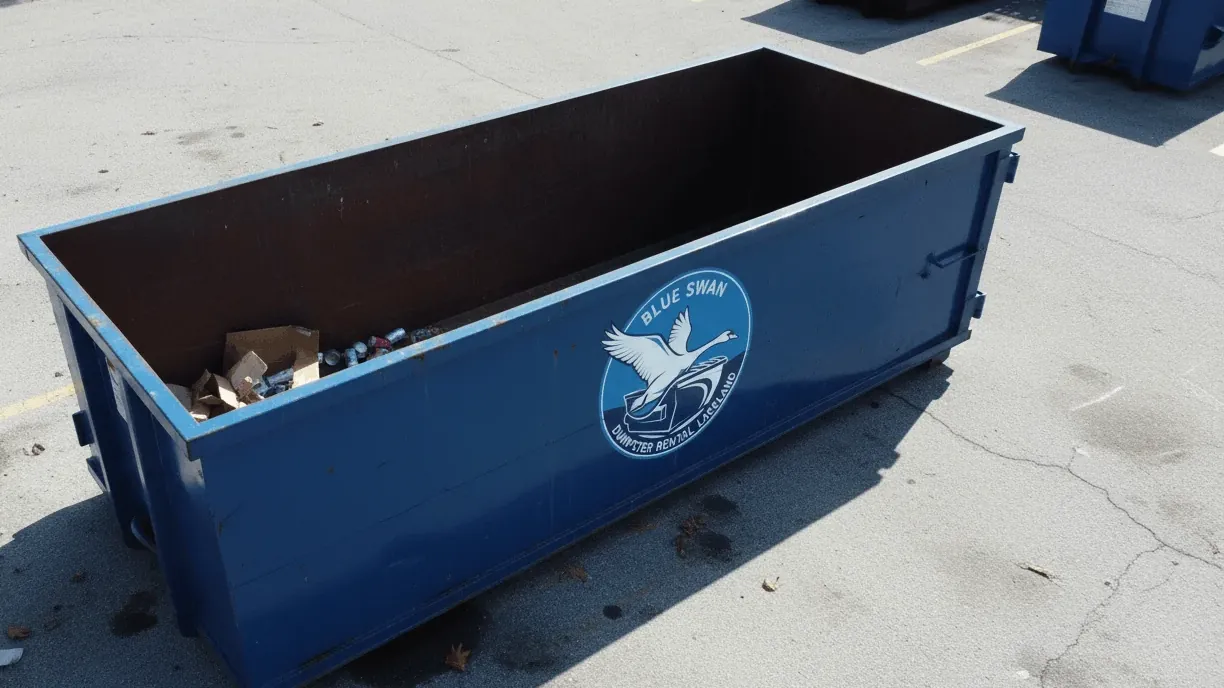
A 10 yard roll-off is roughly twelve feet long, eight feet wide and about three and a half feet tall, which is three or four pickup loads. The short sides mean material goes in over the rim rather than up a ladder, and the short footprint means it will sit on a single-width Lakeland driveway with room left to park. It is the container for heavy, dense material, and the rule that goes with it is short: load flat, load low, and stop at the marked fill line rather than the rim.
- Capacity10 cubic yards
- Footprint12 ft x 8 ft x 3.5 ft
- Weight allowance2 – 3 tons
- Holds about~3 pickup truck loads
Why people choose the 10 yard
Start with the material, because it decides everything else. Masonry rubble is the classic 10 yard load: a broken driveway apron, a section of walk, a patio slab, block from a wall or a planter, mortar, pavers and the compacted base sand underneath them. All of it is several times denser than the mixed household debris people picture when they imagine a roll-off, so the container reaches its lawful payload while the sides are still plainly visible. A 10 loaded flat with rubble is the correct tool for the job. The same rubble in a 30 gives you a container that cannot lawfully leave your driveway, which costs everybody a morning and solves nothing. There is no free route for this material either: neither the City of Lakeland nor Polk County collects construction and demolition debris at the curb from anyone. Soil is its own conversation. If you are excavating as well as breaking out, tell us at booking roughly how much is spoil and how much is masonry, because the two are handled differently and mixing them limits where a load can go.
The second material that belongs in a 10 is roof tile, and in this part of Florida that is not a niche case. The City of Lakeland’s own historic district narratives list Mediterranean Revival and Spanish Mission among the dominant styles in South and East Lake Morton, Dixieland and Biltmore-Cumberland, and those are exactly the roofs that carry concrete and clay tile. Tile is heavier per square than asphalt shingle by a wide margin, it does not compress, and a tear-off delivers the whole weight of the covering in one afternoon. The same logic applies to terrazzo floors and to tile set in a mortar bed, which is what comes up in the bathrooms and kitchens of pre-war Lakeland houses. The mortar is the weight, and it is always more than people expect. Add the condenser pad, the poured steps and the carport footings that tend to come out of the same job and you have a load that is small in volume and serious in weight. Cut any rebar or mesh back below the rim before the truck arrives.
The third case is water, and in Lakeland that is a bigger factor than in most markets. From June through September the city receives more than half of its annual rainfall, almost all of it in near-daily afternoon convection along the I-4 corridor where the sea breezes converge inland. The National Weather Service office at Ruskin publishes climate records for Lakeland as a named station, so this is measured rather than folklore. An open container standing through that pattern catches rain every day it sits there. Saturated carpet, wet drywall, sodden cardboard, soaked yard debris and rained-on masonry fines weigh far more than the same material weighs dry, and they keep gaining for as long as the box stands open. Water is weight you pay to haul at $46.00 a ton as published. So wet material goes in a small container, loaded flat, tarped between sessions, and collected as soon as the space is clear. If a job has been rained on for a week before we arrive, assume it has moved up a weight class.
The last point is that on this size you have a genuine choice of supplier, and we would rather you made it with the numbers in front of you. The City of Lakeland rents 10 yard containers to residential customers inside the city limits, with next-day turnaround on requests taken Monday to Friday between 7 a.m. and 4 p.m. Its published fee schedule is unbundled: $68.00 delivery, $149.59 per haul, disposal passed straight through from the disposal site including tonnage, $2.61 a day if the container is not serviced within 30 days, $40.80 for relocation, blocked access, wait time, dead-head service or container replacement, and a 15 percent franchise fee surcharge on gross billing. Residential customers sign a Hold Harmless agreement. That is a legitimate way to price a public service, and on a light load with a short schedule it can work out well. Our price is flat and all-in, which means the tonnage variable sits with us instead of with you. Call and we will talk it through honestly.
Good fit for
- Broken slab, walk and driveway apron
- Block, mortar and masonry from a wall or planter
- Pavers, edging and the compacted base sand under them
- Concrete and clay roof tile off a tear-off
- Terrazzo and tile set in a mortar bed
- Condenser pads, poured steps and carport footings
- Lifted sod and small quantities of soil or fill
- Anything that has stood open through the rainy season
Not the right size for
- A whole-house declutter with furniture in it
- A garage, carport and lanai cleared in one weekend
- Multi-room remodels making airy debris
- Screen enclosure and lanai cage frame
- Brush, limbs, palm fronds and hedge
- Estate cleanouts of any size
Will it fit?
The 10 is the easiest container we place, and on a Lakeland lot the container is rarely the constraint anyway. At around twelve feet long it will sit on a single-width driveway with room left to park, and its low sides mean material goes in over the rim rather than up a ladder. We still want about 60 feet of straight approach for the truck to line up and back, roughly ten and a half feet of working width, and 20 feet or more of overhead clearance for the hoist. On these flat lots the overhead constraint is usually a live oak limb or a Lakeland Electric service drop rather than a slope. What matters far more is the surface. Polk County is high, sandy ridge country — Lakeland sits at 203 feet and the county high point is 305 feet at Crooked Lake Sandhill — and those deep, loose, well-drained sands will not carry a loaded rubble box on a lawn or an unpaved pad in the wet season. Concrete rather than grass, plywood under the wheels and doubled under the rails, and photographs of the approach on arrival. On fire code, Florida works from NFPA 1 rather than the International Fire Code, so the ten-feet line from national blogs is not the rule here. If any part of the box will sit in the street or the right of way, that needs a Right-of-Way Use Permit through Public Works Engineering first.
Before delivery, move cars and bins, mark irrigation heads and septic lids, and tell us about new concrete, soft or made ground, a low spot that holds water after an afternoon storm, or a service drop hanging under a live oak. A loaded box is several tons on four small contact points, and in the summer rainy season a lawn or an unpaved verge is not a load-bearing surface — the driveway is. Plywood goes under every wheel and under both rails as standard. If any part of the container will sit in a city street, sidewalk or verge, that is a Right-of-Way Use Permit through Public Works Engineering, and the permit provisions name roll-off containers by name. Our delivery and driveway protection guide and our Lakeland placement and permit guide cover the rest.
Compare all five sizes
| Size | Footprint | Weight allowance | Holds about | Best for |
|---|---|---|---|---|
| 10 Yard Dumpster | 12 ft x 8 ft x 3.5 ft | 2 – 3 tons | ~3 pickup truck loads | Concrete, block, roof tile and wet debris — the box that reaches payload before it looks full. |
| 15 Yard Dumpster | 16 ft x 8 ft x 4 ft | 2 – 3 tons | ~4 – 5 pickup truck loads | A single room, a small tear-off, or a garage and carport cleared to the walls. |
| 20 Yard Dumpster | 22 ft x 8 ft x 4.5 ft | 3 – 4 tons | ~6 – 8 pickup truck loads | A whole-house declutter — the Lakeland default — or a multi-room remodel. |
| 30 Yard Dumpster | 22 ft x 8 ft x 6 ft | 4 – 5 tons | ~9 – 12 pickup truck loads | A large remodel or a full estate cleanout, garage and lanai included. |
| 40 Yard Dumpster | 22 ft x 8 ft x 8 ft | 5 – 6 tons | ~12 – 16 pickup truck loads | Commercial gut jobs and construction — it needs the most room to set down. |
Still not sure? Describe what you are throwing away and we will size it on the phone in two minutes. Getting it wrong costs us more than it costs you, so we have every reason to get it right. Call (863) 267-9087.
Book a 10 yard
Flat rate including delivery, pickup, rental period and disposal. Same-day where we can.
(863) 267-9087Other sizes
Popular services
All sizes
Compare our five roll-off containers
10 Yard Dumpster
Concrete, block, roof tile and wet debris — the box that reaches payload before it looks full.
View this size → 15yd³15 Yard Dumpster
A single room, a small tear-off, or a garage and carport cleared to the walls.
View this size → 20yd³20 Yard Dumpster
A whole-house declutter — the Lakeland default — or a multi-room remodel.
View this size → 30yd³30 Yard Dumpster
A large remodel or a full estate cleanout, garage and lanai included.
View this size → 40yd³40 Yard Dumpster
Commercial gut jobs and construction — it needs the most room to set down.
View this size →10 Yard Dumpster FAQs
Why is a small container right for a big pile of concrete?
Because the limit is weight, not volume. Broken concrete, block, mortar, pavers, terrazzo and roof tile are several times denser than mixed household debris, so a container hits its lawful payload long before the sides fill. A 10 yard loaded flat and low goes out at a legal weight. The same rubble in a 30 gives you a container that cannot lawfully move. Load in pieces two people can place rather than pieces one person can drop, spread the material across the whole floor rather than heaping it at the tailgate end, cut any rebar or mesh back below the rim, and stop at the marked fill line even when it feels early.
The City of Lakeland rents a 10 as well. Which should I take?
Compare them honestly and pick on the shape of your job. The City rents 10 and 20 yard containers to residential customers inside the city limits, with next-day turnaround on requests taken Monday to Friday, 7 a.m. to 4 p.m. Its published fees are unbundled: $68.00 delivery, $149.59 per haul, disposal passed through by the ton, $2.61 a day past 30 days, $40.80 miscellaneous and a 15 percent franchise fee surcharge, with a Hold Harmless agreement for residential customers. On a light load over a few days that can be the cheaper route. We quote flat and all-in, and we serve unincorporated Polk and the other municipalities, where the City does not go.
Can I put soil, sand or fill in it?
Tell us before you book rather than after. Excavated sand, soil and fill are a separate conversation from masonry rubble, and mixing the two limits where a load can go, so we want to know roughly what the split is before the container leaves the yard. Digging in Polk has its own habits: this is deep, well-drained ridge sand over carbonate rock, and spoil weighs considerably more wet than dry. Before you break ground, file a locate request with Sunshine 811 — not less than two full business days under § 556.105(1)(a), Fla. Stat. Inside the city, 811 contact 48 hours ahead is also a written condition of the right-of-way permit.
Will it fit on my driveway?
Almost certainly. At around twelve feet long a 10 yard fits on a single-width Lakeland drive and still leaves room to get past it. The things we check are the approach and the overhead: roughly 60 feet to line up and back, about ten and a half feet of width, and 20 feet of vertical clearance for the hoist, which on these lots usually means watching an oak limb or a Lakeland Electric service drop. What we will not do is set a loaded heavy box on grass or on loose ridge sand. Polk sits high and sandy, and that is not a load-bearing surface in the wet season.
How long can I keep it?
As long as the job honestly needs on private ground. Call the yard on (863) 267-9087 when you want it collected and we will fit it into the route rather than hold you to a fixed day. Two things are worth watching on a heavy container. Keep the tarp on, because masonry, tile and demolition fines absorb water and a rained-on load gains real weight overnight; Lakeland takes more than half its annual rain between June and September. And if the box has to sit in the street rather than on your property, the City may require removal from on-street parking on 24 hours’ notice at the permittee’s expense.
Services
What people put in a 10 yard
Residential Dumpster Rental
Driveway placement for the garage, carport and lanai cleanouts a slab-built house produces.
Learn more →Commercial Dumpster Rental
Containers for businesses and contractors — neither the City nor the County collects C&D at the curb.
Learn more →Construction Dumpster Rental
Mixed C&D in one roll-off, with next-day swap-outs across Polk County.
Learn more →Roofing Dumpster Rental
Weight-rated cans sized by squares and layers, tarped against the afternoon rain.
Learn more →Roll-Off Dumpster Rental
10, 15, 20, 30 and 40 yard roll-offs across Lakeland and Polk County.
Learn more →Same-Day Dumpster Rental
Call before the cut-off and we can usually get a container to you this afternoon.
Learn more →Talk to a real person
Need a 10 yard in Lakeland?
Tell us what you are clearing out and we will tell you the right size and the flat price to put it in your driveway. No forms, no waiting on an email — just call and we will sort it out in a couple of minutes.
Serving Lakeland, Polk County and Central Florida · Mon–Fri 6:30am–5pm, Sat 7am–1pm