
Sizes
What Size Dumpster You Need for a Lakeland Job
The 20 yard is the Lakeland default, but weight decides more jobs here than volume does. How the five sizes actually get used in Polk County, and where the City's own residential roll-off line stops.
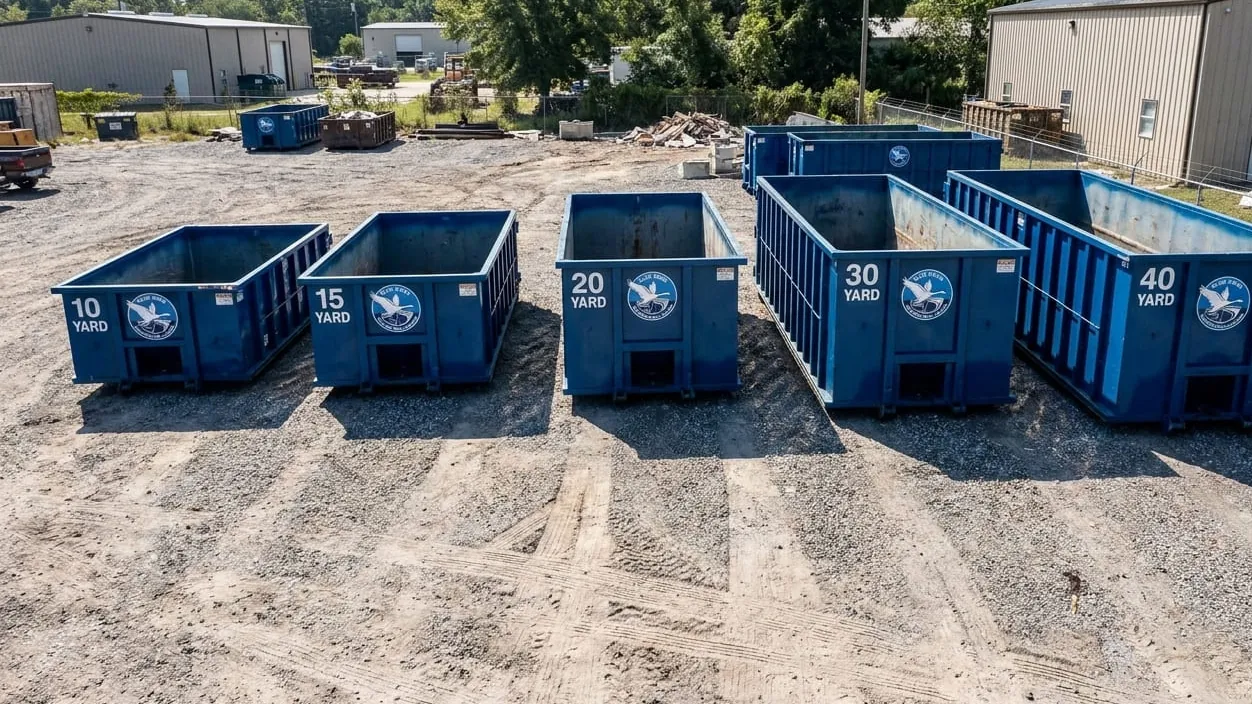
Most calls that begin with a question about size end with a 20 yard container on the driveway. That is the Lakeland default. It has been since Blue Swan started running boxes out of our yard on Combee Road in 2014, and nothing about the way people remodel here has changed that. What does change, job to job, is whether the 20 is actually the right answer, and the reason it is sometimes wrong has more to do with weight than with volume.
Here is how we work through it on the phone.
The 20 yard is the Lakeland default
A 20 yard box holds roughly twenty cubic yards of loose debris. In practice that is a kitchen and two bathrooms, a full garage and attic, a mid-size tear-off, or a whole-house cleanout of a three bedroom home where the furniture is going too. It fits on a standard residential driveway. It does not need the truck to swing wide the way a 40 does. And in a city with narrow streets in the older neighborhoods, that matters more than the extra capacity would.
The 20 is also the size most people underestimate. Debris does not stack like moving boxes. Cabinet carcasses, torn-out shelving, an old sectional and a bathtub take up far more room than their weight suggests. If you are on the line between a 15 and a 20, take the 20. Paying for air you did not use costs less than a second haul.
What the City of Lakeland rents, and where its residential line stops
You should know that we are not the only option inside the city limits. The City of Lakeland runs its own solid waste division, and it rents roll-off containers. It publishes its rates, which is more than most private haulers do.
The detail that matters for a sizing conversation is this: the City’s residential roll-off line stops at 20 yards. Residential customers can get a 10 or a 20. The 20, 30 and 40 yard containers are offered on the commercial side. So if you are a homeowner in Lakeland who has convinced yourself you need a 30 for a whole-house gut, the City is not going to sell you one on a residential account, and you are back to either two pulls on a 20 or a call to a private hauler.
That is not a criticism of the City. It is a real municipal service with next-day turnaround on requests taken Monday through Friday, 7 a.m. to 4 p.m., and residential customers sign a Hold Harmless agreement to get it. It is simply a fact about the sizes available, and it shapes what a Lakeland homeowner actually chooses. We break the two price structures down in detail in our guide to what a dumpster rental costs in Lakeland.
The 10 yard is a weight box, not a small box
People ask for the 10 because it sounds cheap and it sounds like it will fit anywhere. Both are true. Neither is why the 10 exists.
The 10 yard is a weight box. It is what you order when the debris is dense: concrete, block, brick, dirt, roof tile, tile flooring, or anything already soaked. A 10 yard container filled to the rim with broken concrete is heavier than a 30 yard container filled to the rim with furniture, and there is a legal axle limit on the truck that hauls it. Fill a 20 with concrete and we cannot pick it up. Fill a 10 with concrete and we can.
If your job is a driveway removal, a patio, a block wall, a slab section, or a tile roof, start at the 10 and expect to talk about tonnage. That is a concrete and heavy debris job, and it gets quoted differently from a cleanout.
The five sizes side by side
| Size | Typical Lakeland job | What it is really for |
|---|---|---|
| 10 yard | Driveway or patio demo, tile roof, small bath gut, soil | Dense material. The limit is weight, not space. |
| 15 yard | One room, a garage, a small shingle tear-off | The in-between box when a 10 is too tight and a 20 is more than the job. |
| 20 yard | Kitchen and baths, whole garage and attic, most tear-offs | The default. Fits a normal driveway. |
| 30 yard | Large remodel, full estate cleanout, framing scrap | Volume. Bulky light debris that eats space. |
| 40 yard | Commercial, new construction, land clearing debris | Big, light loads with room on site to set it. |
The 15 yard
The 15 is the honest answer for a single room. One bathroom down to the studs, one bedroom cleared out, a two-car garage that has not been touched in fifteen years, or a tear-off under about twenty squares of shingle. It is short enough for a tight driveway in Dixieland or off South Lake Morton, where the setback from the street is small and the driveway is not built for a modern truck.
It is also the size that keeps people out of trouble on mixed jobs. If a room gut includes a small amount of tile or mortar bed, the 15 gives you space for the light material without tempting you to fill a 30 with something heavy.
The 30 yard
The 30 is volume, not weight. Framing lumber, cabinets, drywall, carpet, furniture, siding, a lifetime of stored belongings. It is the right box for a full estate cleanout in an older Lakeland home, where the accumulation is bulky rather than dense. It needs about sixty feet of straight approach to set down cleanly, so on a corner lot or a short driveway it can be the wrong choice even when the volume is right.
The 40 yard
Commercial and construction work. A 40 is roughly the length of two parked cars plus a little, and the truck needs room to lift it. On a new build in one of the subdivisions going up around the county it is easy. On a lot in a historic district it is usually not possible at all.
Weight decides more Lakeland jobs than volume does
Polk County buries its waste. Material from a Lakeland job goes into the ground at the North Central Landfill on De Castro Road in Winter Haven, and it crosses a scale on the way in. As published by Polk County, construction and demolition debris and residential solid waste are billed at $46.00 per ton, yard trash at $36.50 per ton, with a $10.00 minimum, and Polk County has adopted an annual increase of five percent for each of the next five years.
That structure is why weight comes up in every sizing conversation. Two containers of the same size can produce very different disposal charges depending on what is in them. A 20 of drywall, carpet and cabinets is one thing. A 20 with a half yard of broken concrete hidden under it is another.
So when you call, tell us what the debris is, not just how much of it there is. Roof tile, plaster, dirt, brick, and anything that has been rained on all push the number up.
There is one more local wrinkle. The City of Lakeland does not operate a landfill or a transfer station of its own. It runs collection. Its published roll-off fee schedule bills disposal as a direct pass-through from the disposal site, tonnage included. So whether you rent from the City or from a private hauler, somebody is paying the scale, and the scale does not care whose name is on the container.
Where the container is going to sit
Size is partly a delivery question. A container we cannot place is the wrong size no matter how well it matches the debris.
Historic streets
Lakeland has seven local historic districts covering about 1.42 square miles, protecting more than 1,600 historic buildings, with periods of significance running from 1884 to 1953. Munn Park, South and East Lake Morton, Dixieland, Beacon Hill, Biltmore-Cumberland and Lake Hunter Terrace were laid out long before anyone imagined a roll-off truck. Driveways are narrow, oaks hang low, and the street is often the only realistic spot. If the container is going in the street, you are into the City’s Right-of-Way Use Permit, and a smaller box is usually the practical call.
Lakefront lots
The City counts 38 named lakes inside the city limits, from Lake Blanton at about 2.5 acres to Lake Parker at about 2,272 acres, and roughly twelve percent of Lakeland’s area is water. Those lakes are connected through the stormwater system. As the City puts it, what happens upstream can have significant impacts downstream. On a lakefront lot, where a loaded container sits is a stormwater question as much as an access question. Keep it on hard surface, keep it away from the inlet, and keep drywall slurry and demolition dust out of the drain.
Rain is weight you pay to haul
From June through September, Lakeland gets more than half its annual rainfall, and almost all of it arrives in afternoon thunderstorms rolling off the sea-breeze collision along the I-4 corridor. An open container left uncovered through a wet week does not stay at the weight you filled it to.
Water is heavy and it is billed by the ton at the scale. Tarp the box. If you are running a job through the summer, factor that into whether you want one 30 sitting for three weeks or two 20s pulled promptly. The National Weather Service forecast office at Ruskin (TBW) is the forecast authority for Polk County, and in July it is worth a look before you plan an open-top week.
One larger container or two smaller pulls
This comes up on every remodel that runs longer than a weekend. You can rent one big box and let it sit, or rent a smaller one and swap it when it fills. Both are legitimate. The right answer depends on the shape of the job.
Take one larger container when the debris arrives all at once. A tear-off, a garage cleanout, a single day of demolition. Everything hits the box in a compressed window, and a second truck trip buys you nothing.
Take a smaller container and swap it when the work is phased. A kitchen that gets demolished in week one, cabinets pulled in week two, flooring in week three. A box sitting half empty on your driveway for a month is a box you are storing, not using, and in Lakeland’s wet season it is also collecting rain.
There is a jurisdictional wrinkle worth knowing here too. Debris hauled to the North Central Landfill has to come from inside Polk County. The county states plainly that the site is to be used solely by commercial haulers carrying materials from within Polk County. If part of your project is in another county, that material does not go in the same box. It is a small point that almost never matters, and then one day it does. Our service area pages lay out which communities sit inside the city limits and which are unincorporated Polk.
Neither the City nor Polk County collects construction and demolition debris at the curb. That is the whole reason this decision exists. There is no free residential path for a remodel’s worth of debris in this county, and the one Polk convenience center that takes residential construction material sits about 35 miles east of Lakeland, in Haines City, with vehicle-based fees and no commercial use allowed.
How to pick a size over the phone
Four questions get us to the right box almost every time.
- What is the material. Concrete and tile go one way. Furniture and drywall go another.
- How many rooms, or how many squares. Rough is fine. We would rather round up than send a second truck.
- Where does it go. Driveway, side yard, street, or a job site with open ground.
- How long do you need it. Weekend, a week, or a phased remodel with swaps.
If you are still unsure, look at the full size comparison and then call. We would rather spend four minutes on the phone than have you pay for a swap you did not need. Blue Swan Dumpster Rental, (863) 267-9087.
Questions this guide did not answer? Call (863) 267-9087. We would rather spend two minutes on the phone than have you order the wrong container.