
Delivery
Driveway Protection During a Dumpster Delivery in Lakeland
Almost every complaint about a scarred driveway starts with a delivery where nobody asked about the surface first. What we put under the box in Lakeland, and where the City right-of-way begins.
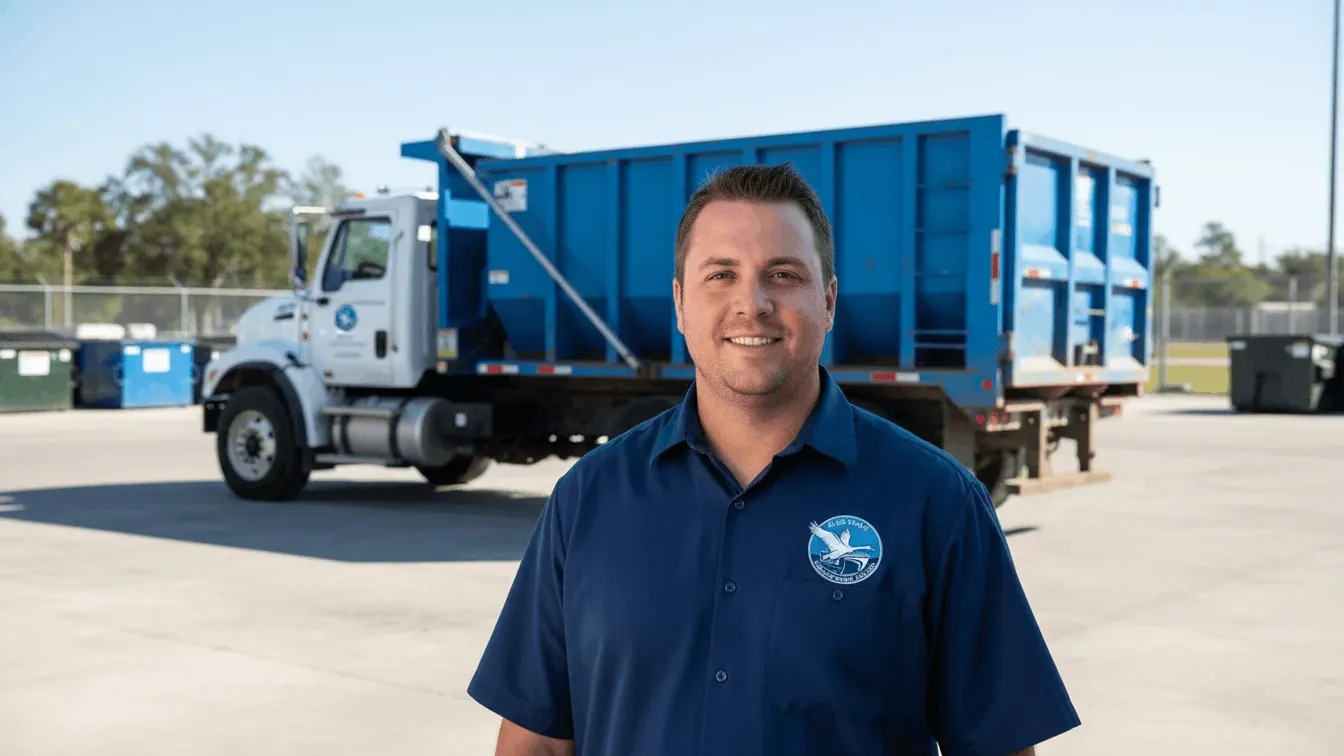
Almost every dumpster we deliver in Lakeland goes on a driveway. That is the right answer for most jobs. It keeps the container on your property, it keeps it out of the right-of-way permit conversation, and it puts the debris where the crew is working.
It also puts several tons of steel and loaded debris on a slab that was poured for a sedan. People worry about that, and they should, because the worry is fixable. Almost every driveway complaint we have ever heard about in Polk County came from a delivery where nobody asked about the surface first.
So we ask. Here is what we ask, why we ask it, and what we put down before the box touches your concrete.
The ground under a Lakeland driveway
Lakeland sits at 203 feet on the high, sandy interior of the peninsula. There are no basements here. Houses are slab-on-grade, and the slab sits on sand that drains fast and compacts poorly. Deep, loose, well-drained sand is soft ground. It carries a car all day and it will still rut under a loaded 30 yard container.
Two things follow from that. First, the edge of a driveway is weaker than the middle, because the sand under the edge has less to hold it in place. Second, an unpaved pad that looks solid in April can be a rut factory in July, when the rainy season has been soaking it every afternoon for six weeks. Both of those are placement decisions, and both are easier to make before the truck rolls than after.
What we put under the container
The standard is plywood. Not a piece of cardboard, not a sheet of visqueen. Three quarter inch plywood, cut into pads, set under the rails and under the wheels at the contact points.
Under the rails
A roll-off container rests on two steel rails running the length of the box. Those rails are where the load concentrates. Boards go under them at the front and rear bearing points on any driveway that is not new, thick, reinforced concrete. That is where a rail can print a line into an older slab or an asphalt drive that has softened in the heat.
Under the wheels
The container has small wheels at the rear that carry the box as it rolls off the truck and as it is winched back on. Those wheels are the highest point load in the whole operation, and they move. A pad under each wheel path takes the scuff out of the set and the pickup.
What the driver is watching
The truck itself is heavier than the box. When a driver stages to unload, the rear axles carry most of that weight in a small footprint. On a narrow driveway with a soft shoulder, we want the truck squared up on the slab, not with one set of duals hanging over the edge into sand. If the approach does not allow that, we would rather tell you on the phone and find a different spot than find out with the box halfway down the rails.
Driveway, not grass
Customers ask for the lawn all the time, usually to protect the concrete. It is almost always the wrong trade.
Grass over sand has no bearing capacity to speak of. A loaded box will sink, and the truck has to drive across the same ground twice to place it and once more to take it. What you get back is two ruts, a compacted strip that will not grow, and sometimes a truck that needs help getting off your yard. In the rainy season it is worse. From June through September Lakeland gets most of its annual rain in afternoon thunderstorms, and saturated sand behaves like a sponge under a wheel load.
If there is genuinely no paved option, we can talk about it. We will want a dry forecast window, a shorter box, a lighter fill, and boards laid down as a running surface. But the default answer on a Lakeland lot is the driveway, protected, every time.
Pavers, stamped concrete and decorative surfaces
These are the surfaces where you have to make a real decision, because we cannot make the risk zero.
| Surface | What happens | What we do |
|---|---|---|
| Newer poured concrete, four inches or more | Handles a loaded container with no trouble | Boards under the rails and wheels as standard |
| Older or thin concrete, visible cracking | Point loads can widen an existing crack | Full board pads, and we place away from the crack line |
| Asphalt | Softens in Florida summer heat and can dent | Boards, and we ask for a morning delivery when we can |
| Brick or concrete pavers | Individual pavers can settle or shift under a rail | Boards, a lighter load, and an honest conversation first |
| Stamped or decorative concrete | The finish can scuff even when the slab is fine | Boards, and we recommend an alternate spot if one exists |
| Shell, sand or dirt pad | Ruts, and the truck may lose traction | Usually we decline, or we lay a board road in dry weather |
On pavers and stamped work, our honest position is that boards greatly reduce the risk and do not eliminate it. If the driveway is the showpiece of the house, put the box on the street with a permit, or find a side pad, or accept the risk knowingly. We would rather have that conversation on the phone than in your driveway.
The swale and the street are right-of-way
This is where Lakeland is unusually specific, and where a lot of generic advice gets people in trouble.
The grass strip between your property line and the pavement is not your yard for these purposes. Neither is the sidewalk, and neither is the street. That is public right-of-way, and in Lakeland the rule is published in plain language. The City states that any work within the City of Lakeland right-of-way of any nature, including road or sidewalk closures, requires a Right-of-Way Use Permit through the Public Works Engineering Division, prior to the start of any work.
The part that matters to us is what comes next. The City's permit provisions address dumpsters and solid waste roll-off containers by name. Most cities have nothing that specific. Lakeland does, and it goes further:
- The City reserves the authority to require removal of a container from an on-street parking space on 24 hours notice.
- If that is not done, the City may remove it at the permittee's expense, and may deny future similar permits.
- Published fee tiers are no fee, $250 and $500, depending on duration and whether a lane or sidewalk is closed. Extensions are published at $500 to $1,500.
- Right-of-way permit questions go to Engineering. The published contact is David Stroud at (863) 834-8437.
- Sunshine 811 notification is a written condition of the permit, not merely a statutory duty. The City's provisions require the permittee to notify the 811 network at least 48 hours before work begins.
That last point catches people. In most places 811 is something you think about when you are digging. In the Lakeland right-of-way it is a term of your permit. You can start a ticket with Sunshine 811, and the City's permit pages are on the City of Lakeland site. We go through the whole permit path in our guide to dumpster permits in Lakeland.
One more wrinkle. If your frontage is on a state road, such as US 98, US 92, SR 33, SR 37, SR 539, SR 540 or SR 563, the right-of-way belongs to the state and the permit path is different. If you are outside the city limits, you are on a county or a private road and the answer changes again. Tell us the road name when you call.
Two Lakelands, two different driveway problems
We serve two housing stocks in the same service area, and they fail in opposite ways.
In the historic core, around Lake Morton, Lake Hunter and Dixieland, the driveways are single width, often original, sometimes two strips of concrete with grass down the middle. They were poured for a car that weighed half what a modern truck does. The street is narrow, the oaks hang low, and the setback is short, so there is rarely room to reposition once the truck is committed. On those lots we plan the whole approach before we leave the yard, and we frequently recommend the smaller box even when the job would justify a bigger one.
Out in the newer subdivisions, where a county that grew 20.7 percent between 2020 and 2025 keeps adding houses, the concrete is thicker and newer and the approach is wide. The problem there is different: the slab is fine, but the drive often runs to a soft, freshly graded shoulder, and the sod is three months old over sand that was never really compacted. One tire off the edge and you have a hole. That is why we ask about the edges, not just the surface.
Either way, the fix is the same. Boards down, truck squared on the pavement, and nobody guessing.
Rain, weight and how long the box sits
The longer a loaded container sits on a driveway, the more the surface underneath has to carry, and in a Lakeland summer that load grows on its own.
An open box left uncovered through a wet week collects rainwater in every void in the load. Water is heavy. Disposal in Polk County is billed by the ton at the North Central Landfill on De Castro Road in Winter Haven, at $46 per ton for construction and demolition debris and $36.50 per ton for yard trash, as published. Rainwater is weight you pay to haul, and it is also weight sitting on your driveway for the duration.
Tarp it. A cheap tarp and four bungees solves the tonnage problem and the driveway problem at the same time. If the job is going to run more than a few days in July, ask us about swapping earlier rather than letting one box sit full and wet.
Loading habits that protect the surface
- Load front to back, low and flat. Concentrating the heaviest material over one rail is how a slab gets a print.
- Keep the load level with the rim. An overloaded box has to be dragged and shifted, and dragging is what scars a driveway.
- Do not put concrete in a big box. Dense debris belongs in a 10 yard. It is a weight box, not a small box, and the sizing logic is on our dumpster sizes page.
- Keep the swing area clear. Cars, trailers, basketball hoops and trash carts all move before delivery day.
- Watch the overhead. The container tips up as it comes off the truck. Low branches and service drops are the most common reason we cannot use the spot you picked.
What to have ready when you call
Give us four things and we can usually settle placement in one phone call: the driveway surface and rough age, the width and length of the clear run, whether the truck can approach straight or has to swing, and whether anything hangs over the approach.
Tell us if you are inside the Lakeland city limits or out in unincorporated Polk. Tell us if the box is going anywhere near the street. And tell us what is going in it, because a load of roof tile and a load of furniture are different weights on the same slab.
Call Blue Swan Dumpster Rental at (863) 267-9087. We have been setting boxes on Polk County driveways out of our yard on Combee Road since 2014, and we would rather spend five minutes on the phone than an afternoon apologizing for a rut.
Questions this guide did not answer? Call (863) 267-9087. We would rather spend two minutes on the phone than have you order the wrong container.