
Roofing
Roofing Dumpster Rental in Lakeland
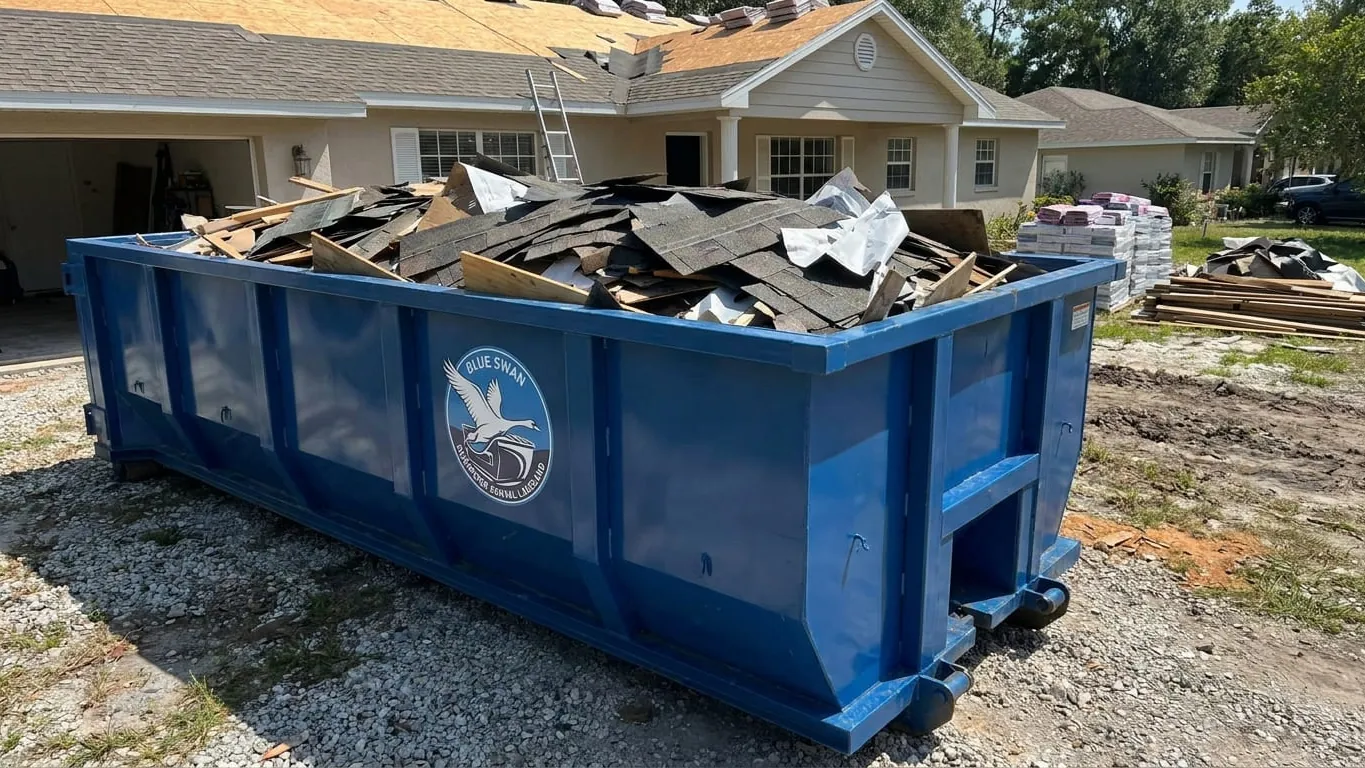
Tear-off containers set where the crew is working, on plywood, on the day. Shingle is heavy and concrete or clay tile is heavier, and in the Lakeland rainy season an open box left uncovered turns into a swimming pool you pay to haul by the ton.
A tear-off is the most predictable container job there is, right up until the material changes. Asphalt shingle runs roughly two to four hundred pounds a square depending on whether it is three-tab or architectural, and a second layer doubles it. Concrete and clay tile are in a different class again: they weigh several times what shingle weighs per square, they do not compress, they break into awkward pieces, and a tile roof delivers the whole weight of the covering in one afternoon. In Lakeland you see all of it. The historic districts have shingle over old decking, the mid-century ranches around Cleveland Heights and Lake Hollingsworth are mostly shingle, and the Mediterranean Revival and Spanish Mission houses the City’s own district narratives list are exactly where the tile is. So the first question we ask is not how big the roof is. It is what is coming off it.
The second question is rain, and here that is not a small factor. From June through September Lakeland gets more than half its yearly rainfall, almost all of it in near-daily afternoon convection along the I-4 corridor, where the Gulf and Atlantic sea breezes meet inland. The National Weather Service office at Ruskin publishes climate records for Lakeland as a named station, so this is measured rather than folklore. An open container standing through a July week does not stay at the weight you filled it to. Felt, wet decking, saturated underlayment and shingle that has soaked all afternoon can weigh half again what they weighed dry, and you pay for that water by the ton at the gate. Tarp the box between sessions. It is the cheapest thing on the job and it is the single piece of advice most roofing customers here wish they had taken.
Where the container sits decides how fast the crew works. The right placement is tight to the eave on the elevation being stripped, close enough to throw or chute into rather than barrow across a lawn, and square enough that shovel loads land inside the rim rather than on the drive. Low sides matter more than capacity on a roofing job, which is why a 15 often beats a 20 even when the volume would fit either. On a Lakeland lot the constraints are usually mature oaks and the Lakeland Electric service drop rather than a slope, since the ground is flat and the driveways are concrete. We need roughly 60 feet of straight approach, about ten and a half feet of working width and 20 feet or more of vertical clearance for the hoist. Plywood goes under the wheels and doubled under the rails, every set, and we photograph the approach when we arrive.
Two local rules are worth knowing before the ladder goes up. First, inside the city limits the City of Lakeland requires a permit for roofing work, with one published exception: minor roof repairs under 25 square feet are exempt. That threshold is a useful line. Below it you are patching a leak; above it you are doing permitted roof work and you will almost certainly want a container. Building Inspection sits at 228 S. Massachusetts Avenue on 863.834.6012. Second, roofing material cannot be burned. Burning yard debris is prohibited inside the Lakeland city limits outright, and construction debris, treated lumber, plastics, rubber, tires, asbestos, roofing materials and tar may not be burned at all under the Fire Department’s published restrictions. Old tear-off does not go on a pile in the back and it does not go in a curbside cart. It goes in a container.
One more thing that sometimes surprises people: Lakeland is not in the High-Velocity Hurricane Zone. That designation covers two counties, and Polk is not one of them, so the product-approval regime you may have read about does not apply here. What does apply is inland storm damage. Polk County has no coastline at all, Lakeland sits at 203 feet, and storm surge is physically inapplicable. What crosses this county is the storm itself. Hurricane Irma’s eye passed over western Polk at Category 2 strength in September 2017 and left eight of every ten homes in the county without power. Hurricane Milton in October 2024 dropped more than 12 inches of rain on Lakeland in 24 hours against a 2.28-inch October normal, which the Weather Service called a 1-in-1,000-year event. Roof damage here is a wind, rain and tree story, and the debris that follows is exactly what a low-side box is for.
Roofing Jobs We Set Containers For
Asphalt Shingle Tear-Off
Three-tab or architectural, one layer or two, plus felt, drip edge and flashing. The commonest Lakeland roof job and the easiest to size, as long as somebody counts the layers before the container is ordered.
Concrete And Clay Tile Removal
Several times heavier per square than shingle and it does not compress. Tile gets a small box loaded flat across the whole floor, in pieces two people can place rather than pieces one person can drop.
Second-Layer Discovery
The layer nobody knew about. It doubles the weight and it is the commonest reason a container that looked right at booking is suddenly too small. Call us and we will swap rather than let you overload it.
Decking Replacement
Rotten sheathing, fascia, soffit and the odd rafter tail. Wood is bulky and it soaks up water fast, so it goes out sooner rather than standing open through an afternoon of storms.
Flat And Low-Slope Roofs
Modified bitumen, built-up layers, gravel ballast and old insulation board off a commercial unit. Gravel is dense enough to change the box you want, so tell us if it is there.
Storm Damage Repair
Blown-off sections, lifted ridge, damaged valleys and the tree limb that started it. Wind and tree damage is the inland Polk pattern, and the load is usually roofing and vegetation mixed.
Skylights, Vents And Solar Removal
Curbs, flashing kits, old ventilators, mounting rails and glazing. Small in volume, awkward in shape, and easiest to handle in the same container as the tear-off rather than a second trip.
Re-Roof On A Historic House
Narrow streets, mature oaks, close setbacks and a design review sitting over the whole job. Placement is the constraint, so a low-sided 10 or 15 close to the eave usually beats a bigger box parked further away.
Sizing A Tear-Off Container
Count squares and count layers, then decide by weight rather than volume. A 10 yard is right for a small roof, for any tile job, and for anything with gravel ballast in it, because those loads reach a lawful payload while the container still looks half empty. A 15 yard covers the majority of single-layer shingle re-roofs on a Lakeland house and has the low sides a crew wants beside the ladder. A 20 yard suits a large or complex roof, a two-layer tear-off, or a job where decking is coming off with the covering. Above that you are usually better with two pulls than one very tall box, because a roofing load is easy to overload and hard to unload once it is over the line. Tile and gravel always get their own container. Sizes and dimensions are on the container sizes page, and our tear-off guide works through squares and layers in detail.
10 Yard Dumpster
Concrete, block, roof tile and wet debris — the box that reaches payload before it looks full.
View this size →15yd³15 Yard Dumpster
A single room, a small tear-off, or a garage and carport cleared to the walls.
View this size →20yd³20 Yard Dumpster
A whole-house declutter — the Lakeland default — or a multi-room remodel.
View this size →Placement, Rain And Protecting The Drive
Roofing containers take a beating, so protection is not optional. We set on plywood under the wheels and doubled under the rails, on concrete rather than on grass or sand, and we photograph the approach on arrival. Lakeland driveways are flat, so the constraint is overhead: a live oak limb or a Lakeland Electric service drop decides where the box can go far more often than a slope does. We want roughly 60 feet of straight run for the truck, about ten and a half feet of width and 20 feet or more of vertical clearance for the hoist. Once it is set, the rain is the thing to manage. More than half of Lakeland’s annual rainfall arrives between June and September in afternoon storms, and a tarp over an open tear-off box is the difference between hauling shingle and hauling shingle plus water at $46.00 a ton as published. Nails are the other everyday hazard: sweep the drive and run a magnet before the truck comes back, because a container that leaves clean saves an argument about a tire. On fire code, Florida works from NFPA 1 rather than the International Fire Code, so the ten-feet line from national blogs is not the rule here. We keep containers clear of the eaves, the meter and the condenser as a matter of practice.
Not sure this is the right service? Describe the job on the phone and we will point you at the right container even if it is a different service page. Call (863) 267-9087.
Get a flat quote
Two minutes on the phone gets you a size, a price and a delivery slot. No forms.
(863) 267-9087Recommended sizes
How it works
Roofing Dumpster Rental in four steps
- 1
Call us
Tell us the project, your address and when you want it. Two minutes on the phone and you have a flat price.
- 2
We deliver
Our driver walks the drop, lays protection boards and sets the container exactly where you want it.
- 3
You load it
Take your time within your rental window. Keep it level with the top rail and we handle the rest.
- 4
We haul it
Call or text when you are done. We pull it, sort what can be recovered and dispose of the rest properly.
Roofing Dumpster Rental FAQs
What size do I need for a tear-off?
Squares and layers decide it. For a single layer of asphalt shingle on an ordinary Lakeland house, a 15 yard is usually right and its low sides make loading faster. Two layers, a large or cut-up roof, or decking coming off with the covering, and you are into a 20. Concrete or clay tile goes in a 10 regardless of how small the roof looks, because tile is several times heavier per square than shingle and does not compress. Same for a gravel-ballasted flat roof. If you are between sizes, take the smaller box and plan a swap; an overloaded container cannot lawfully leave the property and that costs everybody a morning.
Why does the tarp matter so much here?
Because water is weight and you pay for it by the ton. From June through September Lakeland gets more than half its yearly rain, almost all of it in near-daily afternoon thunderstorms along the I-4 corridor. Felt, underlayment, wet decking and soaked shingle can gain half their weight again standing open through a single wet week, and the published gate rate for construction and demolition debris at the North Central Landfill is $46.00 a ton, effective October 2025 and rising five percent a year for five years. Tarping between sessions costs nothing and is the most reliable saving on the whole job.
Do I need a permit to re-roof in Lakeland?
For anything beyond a small patch, yes. The City of Lakeland Building Inspection Division lists roofs among the work requiring a permit, and its published exemption list covers minor roof repairs under 25 square feet. So under 25 square feet you are patching; above it you are doing permitted roof work. Building Inspection is at 228 S. Massachusetts Avenue on 863.834.6012. Outside the city limits the Polk County Building Division in Bartow handles it on (863) 534-6080. Neither of those is a permit for the container itself — that only arises if the box sits in the right of way.
Can I burn the old roofing material instead?
No, and this one is unambiguous. Burning yard debris is prohibited within the City of Lakeland outright, and the Fire Department’s published restrictions prohibit burning construction debris, treated lumber, plastics, rubber, tires, asbestos, roofing materials and tar anywhere. Burn authorizations for anything that is allowed moved to the Florida Forest Service district office on (863) 940-6701 back in September 2016. Old shingle, felt and tile are not curbside material either: neither the City nor Polk County collects construction and demolition debris at the curb from anyone. A container is the route.
Is Lakeland in the High-Velocity Hurricane Zone?
No. The High-Velocity Hurricane Zone covers two Florida counties and Polk is not one of them, so the product-approval requirements you may have read about for those counties do not apply in Lakeland. What does apply here is inland storm exposure. Polk County has no coastline, Lakeland sits at 203 feet, so nothing arrives here off the water — but the storms cross this county: Irma’s eye passed over western Polk at Category 2 in 2017, and Milton dropped more than 12 inches on Lakeland in 24 hours in October 2024. For a site-specific wind design figure, ask Building Inspection on 863.834.6012.
More services
Other things we haul
Residential Dumpster Rental
Driveway placement for the garage, carport and lanai cleanouts a slab-built house produces.
Learn more →Commercial Dumpster Rental
Containers for businesses and contractors — neither the City nor the County collects C&D at the curb.
Learn more →Construction Dumpster Rental
Mixed C&D in one roll-off, with next-day swap-outs across Polk County.
Learn more →Roll-Off Dumpster Rental
10, 15, 20, 30 and 40 yard roll-offs across Lakeland and Polk County.
Learn more →Same-Day Dumpster Rental
Call before the cut-off and we can usually get a container to you this afternoon.
Learn more →Junk Removal Dumpsters
Clear a garage, carport, lanai or spare room on your own schedule.
Learn more →Estate Cleanout Dumpsters
Discreet, patient container service for families clearing a lifelong home.
Learn more →Demolition Debris Removal
Containers and fast swaps for lanais, carports, sheds, garages and interior gut-outs.
Learn more →Concrete & Heavy Debris
Dedicated heavy cans for concrete, block, roof tile and rubble on sandy ground.
Learn more →Yard Waste & Brush Removal
Clean separate loads for oak limbs and palm fronds — burning yard debris is prohibited in the city.
Learn more →Where we deliver
Roofing Dumpster Rental across Polk County and Central Florida
Same service, same flat rates, every town below. Pick yours for local placement and permit notes.
Talk to a real person
Need roofing dumpster rental in Lakeland?
Tell us what you are clearing out and we will tell you the right size and the flat price to put it in your driveway. No forms, no waiting on an email — just call and we will sort it out in a couple of minutes.
Serving Lakeland, Polk County and Central Florida · Mon–Fri 6:30am–5pm, Sat 7am–1pm