
Roofing
Roofing Tear-Off Dumpster Size Guide for Lakeland
A tear-off is a weight problem dressed up as a volume problem. Squares, layers, shingle against tile, and why the rainy season quietly adds tons to an open container in Polk County.
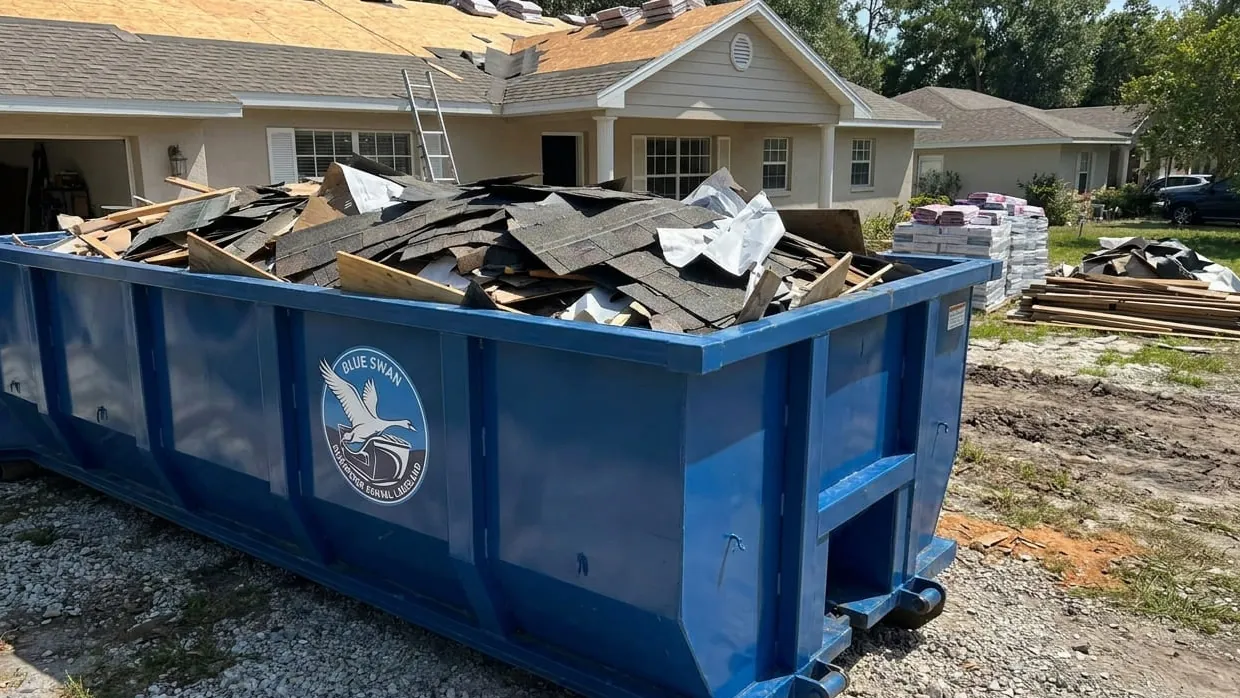
A roofing container is the one rental where getting the size wrong is expensive in both directions. Order too small and the crew stops mid-tear-off while a second box is dispatched. Order too large and you have paid for space you could not legally fill anyway, because the truck hit its weight limit before the box hit its rim.
Tear-offs are a weight problem dressed up as a volume problem. Here is how we size them in Lakeland.
Start with squares, not cubic yards
Roofers measure in squares. One square is 100 square feet of roof surface. A typical single-story Lakeland ranch runs somewhere in the range of 20 to 30 squares. A two-story house with a complex roof line can run 35 to 50.
Get the square count first, then the number of layers, then the material. Those three numbers get you to a container size. Square footage of the house is not the same as square footage of the roof, and on a low-slope Florida roof with wide overhangs the difference is larger than people assume.
Measure the roof, not the footprint. Multiply the length by the width of each plane, add the planes together, and divide by 100. On a hip roof with dormers that takes a few minutes and it beats guessing by a wide margin. If a roofer has already quoted the job, the square count is on the proposal — read it off there.
Count layers honestly. A second layer of shingle over the original doubles the tonnage without changing the roof’s footprint at all, and on older Lakeland houses a hidden second layer turns up more often than anyone would like.
What the material weighs
These are working trade figures, not published code values. Use them to pick a container, and expect real loads to vary with age, saturation and how much felt, flashing and decking comes off with the covering.
| Roof covering | Rough weight per square | 20 squares, one layer |
|---|---|---|
| Three-tab asphalt shingle | about 200 to 250 lb | roughly 2.0 to 2.5 tons |
| Architectural or dimensional shingle | about 350 to 450 lb | roughly 3.5 to 4.5 tons |
| Concrete tile | about 900 to 1,100 lb | roughly 9 to 11 tons |
| Clay tile | about 600 to 1,000 lb | roughly 6 to 10 tons |
| Metal panel | light, but bulky and awkward | volume governs, not weight |
Two things fall straight out of that table.
Asphalt is a volume conversation with a weight ceiling. Architectural shingle is roughly twice the weight of three-tab per square, and a lot of Lakeland re-roofs going on now are replacing architectural product installed in the last twenty years.
Tile is a different animal entirely. A tile tear-off is a heavy-debris job. It belongs in a 10 yard container, sometimes two of them, and the conversation is about tonnage from the first sentence. Filling a 20 with concrete tile produces a load nobody can legally haul.
Matching the size to the tear-off
Asphalt shingle
- Up to about 15 squares, single layer: a 15 yard container is usually enough.
- Roughly 15 to 30 squares: the 20 yard. This is the Lakeland default for residential re-roofs and it covers most of them.
- Over 30 squares, or two layers, or a lot of decking: a 30 yard, or a 20 with a scheduled swap partway through.
Metal and flat roofs
Metal panel is light but awkward. Long panels do not nest, they bridge across the container and leave dead air underneath, and a box that looks full is often half empty. Break the panels down or expect to use more volume than the weight suggests. Flat and low-slope roofs with built-up layers or modified bitumen behave more like tile: heavy, dense, and better suited to a smaller container with an extra pull.
Tile
- Any size tile tear-off: start at the 10 yard and plan on multiple pulls. Weight, not space, is the constraint.
If your job sits on a boundary, take the larger box or plan the swap in advance. A crew standing around waiting on a truck costs more than the container does. See the full size comparison for how the five sizes get used across other job types.
Weight is billed at the scale
Polk County buries its waste, and everything gets weighed. Debris from a Lakeland roof goes to the North Central Landfill on De Castro Road in Winter Haven. As published by Polk County, construction and demolition debris is $46.00 per ton, with a $10.00 minimum per load, and the adopted schedule raises rates five percent a year for five years.
Run that against the table above. A 25 square architectural tear-off is somewhere near five tons before you add felt, flashing and any rotten decking. That is a real number on a real invoice, and it is the same number regardless of who hauls the container. What varies between quotes is how much tonnage is included before overage starts.
Ask for the included allowance in tons, in plain language, before you book. Anyone who will not say is telling you something.
Decking is the variable people forget. A tear-off that uncovers soft sheathing turns into a partial re-deck, and plywood adds volume and weight that was not in the original estimate. If the roof is old enough that you are worried about it, size for the possibility rather than the plan. It is easier to leave a foot of freeboard than to call for an unscheduled swap on a Thursday afternoon.
Do not mix a tile tear-off with a concrete driveway removal or a slab section in the same box either. Both are heavy debris, and combining them is the fastest way to build a load that legally cannot leave your property.
The rainy season and an open box
More than half of Lakeland’s annual rainfall lands between June and September, almost all of it in afternoon thunderstorms firing along the sea-breeze convergence over the I-4 corridor. Roofing season and storm season are the same season here.
Two consequences.
Tarp the container. Asphalt shingle, felt and old decking hold water, and water is weight you pay to haul at the published per-ton rate. A tarp is the cheapest cost control on the job. Tarp the roof too, obviously, but do not forget the box.
Plan the pull around the forecast. A full container left open through three storm days gets heavier for no reason. The National Weather Service forecast office at Ruskin (TBW) is the forecast authority for Polk County and is worth checking the morning you schedule a haul.
Where the box goes on tear-off day
Placement on a roofing job is different from placement on a cleanout, because you want the container directly under the fall line and you want it there for a short, intense window.
Driveways
Most Lakeland re-roofs run off the driveway. Put plywood or planks under the wheels and the rails. A loaded roofing container concentrates several tons onto a small footprint, and Florida driveways are slab on grade with no basement or crawlspace underneath to spread the load. Fresh sealcoat, pavers and older concrete all mark. Our page on driveway protection at delivery covers the details.
Historic streets
In Munn Park, Dixieland, Beacon Hill, Lake Hunter Terrace or around Lake Morton, the driveway may be too narrow or too short. If the container goes in the street, the City of Lakeland requires a Right-of-Way Use Permit through Public Works Engineering, and the City can require removal from an on-street parking space on 24 hours’ notice. Plan for the shorter placement and the smaller box.
Lakefront lots
One more placement note. Roofing crews work fast and the debris arrives all at once, so the container needs a clear approach on both the delivery and the pull. Move the vehicles the night before. A dead-head trip because a car was parked behind the box is a charge on somebody’s invoice, and it is entirely avoidable.
Lakeland has 38 named lakes and roughly twelve percent of the city’s area is water, all of it connected through the stormwater system. Granules, felt scraps and nail debris wash easily. Keep the container on hard surface and away from the storm inlet, and sweep the drive before the truck leaves.
Permits and code, without the myths
Two things worth stating plainly.
The 25 square foot threshold. Inside the Lakeland city limits, minor roof repairs under 25 square feet are exempt from permit. Above that you are doing permitted roof work through the Building Inspection Division at (863) 834-6012, and you are almost certainly renting a container. In unincorporated Polk the Building Division in Bartow, (863) 534-6080, handles it.
Wind provisions. Florida’s toughest wind-borne debris requirements were written for Miami-Dade and Broward counties. Lakeland is not in that zone. What governs a re-roof here is the Florida Building Code, 8th Edition (2023), enforced by your local building department. The Florida Building Commission publishes the code. Ask your roofer about fastening schedules and secondary water barrier, not about a zone that does not apply.
Also: there is no frost line in Florida, and nobody is tearing off a roof around a freeze. The scheduling constraint here is rain and heat, not cold.
Asbestos and older roofs
Old built-up roofing and some older roofing felts and mastics can contain asbestos. If the building is not a single-family home of four or fewer units, or if it has served commercial purposes, that is a regulated situation and it starts with a survey by a licensed consultant.
The notice goes to Florida DEP Southwest District, Temple Terrace, (813) 470-5700 — not to a county agency, because Polk County is not one of Florida’s eight delegated local air programs. The filing is due at least 10 working days before the start date, at the published fee of $200 for a paper submission or $100 filed electronically and paid at the same time.
And the hard local rule: the North Central Landfill does not accept asbestos. It cannot go in the roofing container. It goes to a permitted facility, and the DEP district office holds the list.
Lead comes up on older roofs too, usually in flashing and in painted trim disturbed during the work. The EPA Renovation, Repair and Painting rule applies to housing built before 1978, and Lakeland has seven historic districts with more than 1,600 historic buildings whose periods of significance end no later than 1953. If your re-roof is on a pre-war house, assume the rule is in play and hire accordingly.
What to tell us when you call
- Squares, or the roof dimensions if you have them.
- Material — three-tab, architectural, concrete tile, clay tile, metal.
- Layers, and whether decking is coming off.
- Where the container goes, and whether the driveway can take it.
- The day the crew starts, so the box lands the morning of and not four days early.
Give us those five and we will name a size and an included tonnage on the same call. Blue Swan Dumpster Rental, (863) 267-9087.
Questions this guide did not answer? Call (863) 267-9087. We would rather spend two minutes on the phone than have you order the wrong container.