
Construction
Construction Debris Disposal in Polk County, Florida
Polk County is not one of Florida's eight delegated air programs, so the asbestos notice goes to the state, not a county desk. Ten working days, $200 on paper or $100 filed and paid online.
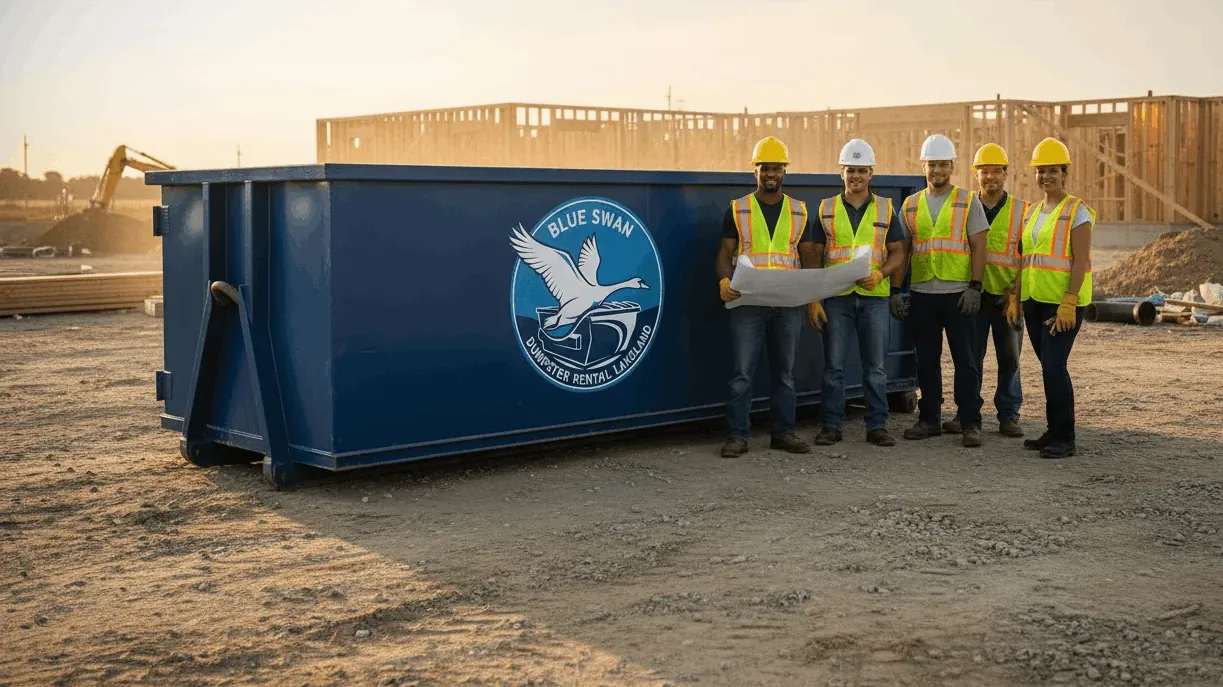
Construction and demolition debris is the one category of waste in Polk County that nobody picks up for you. The City of Lakeland excludes it from curbside service and points you at roll-off containers. Polk County lists it among the things it does not collect. There is no bulky day for it and no special cart.
So the question on a Lakeland job site is never whether you need a container. It is what goes in it, what legally cannot, and which agency you owe a notice to before the first wall comes down.
Some of that is straightforward. One piece of it — asbestos — catches contractors who have worked in neighboring counties, because the notice in Polk County goes to the state, not to a county agency. That is the part to get right.
What counts as C and D debris here
Polk County’s own code defines construction and demolition debris as discarded materials generally considered not water-soluble and nonhazardous, including steel, glass, brick, concrete and lumber from construction or destruction projects, together with clean cardboard, paper, plastic, wood, metal scraps, yard trash and de minimis amounts of other nonhazardous wastes from such projects.
In practice that is the ordinary content of a renovation container: framing lumber, drywall, roofing, siding, flooring, cabinetry, trim, subfloor, windows, doors, concrete and block.
What it is not is a catch-all. The word nonhazardous is doing real work in that definition, and the exclusions below are where jobs go wrong.
It is also worth separating C and D debris from land clearing. Whole trees, stumps and root systems come off a lot in volumes that dwarf a bathroom remodel, and they are yard trash at the scale rather than construction debris, at a different published rate. If a lot is being cleared and a structure is coming down in the same week, those are two loads and two rates. Say so when you call, and we will plan the containers around it rather than mixing everything into one box and paying the higher number on all of it.
Where it goes, and what it costs
Polk County buries. Debris from a Lakeland job goes to the North Central Landfill, 7425 De Castro Road, Winter Haven, and it is weighed on the way in.
As published by Polk County, construction and demolition debris is $46.00 per ton, residential solid waste is $46.00 per ton, yard trash is $36.50 per ton, and the minimum charge is $10.00 per load. The resolution setting those rates also provides for a five percent increase each year for five years.
There is a jurisdictional rule at that gate that matters on multi-site work. The county states the landfill is to be used solely by commercial haulers carrying materials from within Polk County, and out-of-county waste is not accepted. Where the debris came from is a legal question, not a formality.
One more thing about the destination. The City of Lakeland runs collection only — it operates no landfill and no transfer station of its own, and its published roll-off fee schedule bills disposal as a direct pass-through from the disposal site including tonnage. Whoever hauls your container, somebody pays the scale.
Because disposal is billed by weight, the composition of the load drives the invoice. A container of framing scrap and drywall behaves very differently from one with a half yard of broken slab in the bottom. Talk through the mix before the box arrives — our sizing guide walks through how weight decides the container.
Asbestos: the notice goes to the state
This is the single most misunderstood requirement on a Polk County demolition, and the reason is geographic. Florida has eight approved local air programs that take asbestos demolition and renovation notices for their own jurisdictions. Polk County is not one of them.
Because there is no delegated local program here, the notice goes to Florida DEP. Polk County falls in the DEP Southwest District, whose office is in Temple Terrace at (813) 470-5700.
Say that out loud on your next Polk job, because contractors who work across the county line are used to filing with a county agency and there is no county agency to file with here. It is a state notification.
The timing and the fee
- The form is the Notice of Demolition or Asbestos Renovation.
- It must be postmarked or received at least 10 working days before the project start date.
- The fee, as published, is $200 for a hard copy submission, or for an electronic submission paid later on invoice.
- The fee is $100 for an electronic submission through the DEP Business Portal with payment made at the same time.
Filing electronically and paying at the same moment halves the fee. That is worth ten minutes of anyone’s time. The notification procedure and fee rule is Rule 62-257.301, Florida Administrative Code, part of Chapter 62-257 which implements the federal asbestos program in Florida. Confirm the current figures with Florida DEP.
The survey comes first
A thorough inspection for asbestos is required before any demolition or renovation. DEP does not perform the testing. The owner or operator hires a licensed asbestos consultant, and under § 469, Florida Statutes, that consultant holds a specific credential — an architect, professional engineer or professional geologist license, a Diplomate of the American Board of Industrial Hygiene, or a Certified Safety Professional designation. DBPR handles the licensing.
One limitation in that chapter surprises people: an asbestos contractor may not perform abatement work that affects building structures or systems. Structural work requires a contractor licensed under chapter 489. On a real demolition you may be hiring two licensed trades, not one.
The residential exemption, stated precisely
Single-family homes with four or fewer dwelling units are exempt from the federal requirements, provided the building has not served commercial purposes and will not be replaced by a commercial structure. Condominium complexes and multi-unit residential buildings remain fully regulated.
Gutting your own bathroom in a Dixieland bungalow is one legal situation. A fourplex or a condo building is another one entirely. Do not read the first as covering the second.
Asbestos cannot ride in the container
Here is the hard local “no.” The North Central Landfill does not accept asbestos. It is on the county’s refused list alongside bulk liquids, pressurized tanks and explosives.
So asbestos-containing material from a Lakeland job cannot go into a roll-off headed for Winter Haven. It has to be sealed in leak-tight containers, labeled with generator information and the required warnings, and delivered to a permitted disposal site. DEP district offices maintain the list of approved sites, and the Southwest District office at (813) 470-5700 is where to ask which facility is closest.
If you are not sure whether a material is regulated, stop and test. Discovering it at the scale is worse and more expensive than discovering it in the plan. Our demolition debris service is built around sorting that out before the container goes out.
Lead, and why it bites harder in Lakeland
The EPA’s Renovation, Repair and Painting rule applies to homes, child care facilities and preschools built before 1978. Firms doing renovation, repair or painting that disturbs lead-based paint must be EPA-certified, and individual certified renovators must follow specified work practices. It is a federal rule, and firms apply to EPA directly for certification.
In a 1990s subdivision that rule is background noise. In Lakeland it is the default condition of the job.
The City has seven local historic districts covering about 1.42 square miles, protecting more than 1,600 historic buildings and 13 individual landmarks. The periods of significance run from 1884 to 1953 — Munn Park 1884 to 1946, South and East Lake Morton 1900 to 1942, Dixieland 1905 to 1940, Biltmore-Cumberland 1922 to 1953, Beacon Hill 1923 to 1945, Lake Hunter Terrace 1924 to 1951. Every structure in those districts predates 1978.
And that is only the protected stock. Lakeland was incorporated on 1 January 1885 and grew as a railroad city; there is a great deal of pre-war housing outside the district boundaries too. Meanwhile the county around it grew about 20.7 percent between 2020 and 2025. Two Lakelands, one service area: a pre-war core where the lead rule is assumed, and new subdivisions where it is not.
The homeowner exemption has carve-outs that matter. Homeowners working on their own home are generally exempt unless they rent the property, run a child care operation there, or buy and renovate homes for profit. In an older city with a lot of rental stock, that carve-out catches more projects than people expect.
What else stays out of the box
Beyond asbestos, the exclusions on a Polk County construction job are short and worth memorizing.
- Household hazardous waste — paint, solvents, motor oil, antifreeze, pesticides, fuel, batteries, fluorescent tubes. The county facility is at 5 Environmental Loop South in Winter Haven, open Friday and Saturday mornings only, free to non-commercial residents. A small business hazardous waste program runs by appointment.
- Tires — handled separately, not as ordinary waste. Statewide, whole waste tires are restricted from landfills under § 403.708(12), Florida Statutes.
- Bulk liquids, pressurized tanks and explosives — refused at the gate.
- Anything from outside Polk County — the origin rule again.
Florida DEP regulates solid waste management facilities under Chapter 62-701, Florida Administrative Code, with Rule 62-701.730 covering C and D debris disposal and recycling. That is the statewide backdrop; the exclusions above are what you actually apply on a Tuesday morning.
Who to call, at a glance
| Question | Agency | Number |
|---|---|---|
| Asbestos notice before demolition or renovation | Florida DEP Southwest District, Temple Terrace | (813) 470-5700 |
| Demolition permit inside the city limits | City of Lakeland Building Inspection | (863) 834-6012 |
| Demolition permit in unincorporated Polk | Polk County Building Division, Bartow | (863) 534-6080 |
| Container in a City of Lakeland street | City of Lakeland Public Works Engineering | (863) 834-8437 |
| Landfill accounts and disposal questions | Polk County Solid Waste, Winter Haven | (863) 284-4319 |
| Design review in a historic district | City of Lakeland Historic Preservation | (863) 834-6011 |
Six numbers cover almost every Polk County demolition. None of them is a general information line, and all of them will give you a straight answer faster than a web search will.
Sequencing a Lakeland demolition
The order matters more than any single step.
- Survey first. Hire a licensed consultant and find out what is in the building before you plan the schedule.
- File the DEP notice at least 10 working days out. Electronic with immediate payment, at $100, rather than paper at $200.
- Pull the demolition permit. Inside the city limits that is Building Inspection at (863) 834-6012; in unincorporated Polk it is the County Building Division in Bartow at (863) 534-6080. Demolition requires a permit regardless of size in both.
- Notify Sunshine 811 at least 48 hours before any excavation. Inside Lakeland it is also a written condition of the City’s right-of-way permit.
- Set the container where the truck can service it, and get the right-of-way permit if it goes in the street.
We can tell you which of those steps apply to your address, and we would rather do it before the box is on site than after. Blue Swan Dumpster Rental, (863) 267-9087.
Questions this guide did not answer? Call (863) 267-9087. We would rather spend two minutes on the phone than have you order the wrong container.