
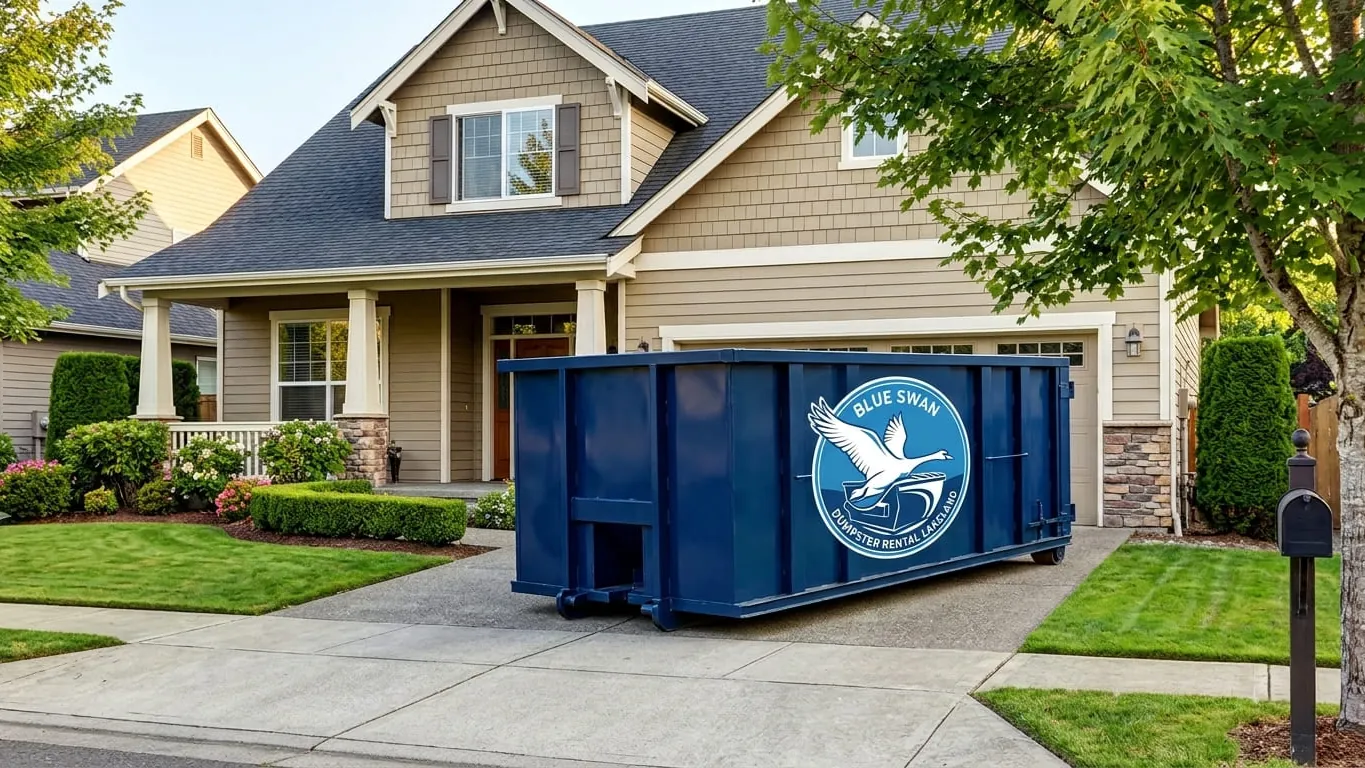
Lakeland, FL · Polk County
Dumpster Rental in Lakeland, FL — Delivered Fast, Priced Flat
10 through 40 yard roll-off dumpsters for homeowners, contractors and businesses across Lakeland and Central Florida. One phone call, one flat price, and a driver who protects your driveway. Locally owned since 2014.
- Same-day & next-day delivery
- Flat rates that include disposal
- Driveway protection boards as standard
- Licensed, insured and locally owned
Licensed & insured · Flat-rate quotes · Locally owned since 2014
Why Blue Swan Dumpster Rental
The dumpster company Lakeland calls back
Most people renting a dumpster are already having a stressful week. The kitchen is in pieces, the roof is half off, or a family member has passed and there is a house full of forty years to sort out. The last thing anyone needs is a hauler who quotes one price, invoices another, and drops a container across the mailbox.
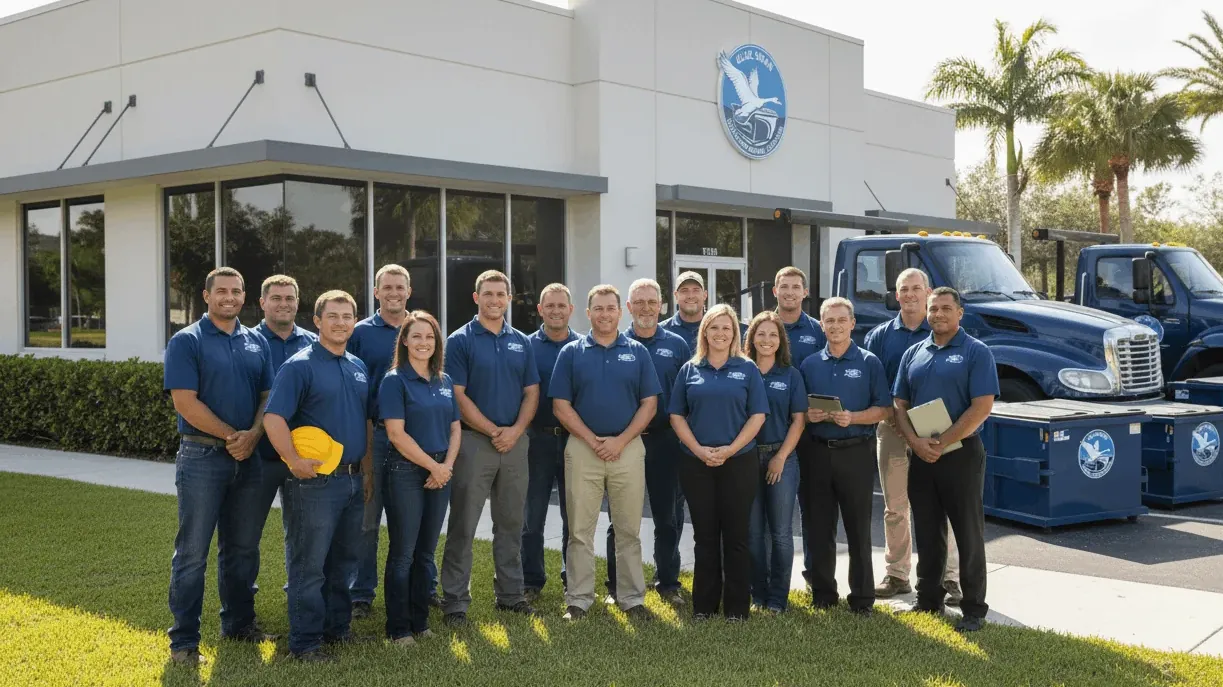
We started Blue Swan Dumpster Rental in 2014 with one truck and one rule: tell people the truth about what it costs and show up when we said we would. 12 years later that has not changed. Marcus Iveson still answers the phone most mornings, and our drivers still walk the drop before they back in.
We run out of 1602 Combee Rd, with I-4, US 92 — Memorial Boulevard — US 98, SR 33, SR 539, SR 570 (the Polk Parkway) and Combee Road close enough that we cover the county every day rather than routing a truck in from another market when you need a container this afternoon. It also means we know whose rulebook your address sits under, and around here that is most of the job. Lakeland is a city, and it does almost everything itself. It was incorporated on 1 January 1885, runs a Commission-Manager government, and operates its own solid waste division, fire department, police department, electric utility, water utility, airport and engineering permit desk. It is one of 17 municipalities in Polk County — 13 Cities, 3 Towns and 1 Village — so two addresses a few miles apart can answer to the city counter, to the County, or to a different city entirely. Three things land straight on your driveway from that. First, the street rules here are written down. The City states that “any work within the City of Lakeland right-of-way of any nature, including road or sidewalk closures, will require a Right-of-Way Use Permit through the Public Works Engineering Division, prior to commencement of any work,” and the permit provisions name dumpsters and roll-off containers explicitly. Fees run $0, $250 or $500 by tier, with extensions from $500 to $1,500, as published; Engineering sits at 228 S. Massachusetts Avenue and the contact is David Stroud on (863) 834-8437. Notifying Sunshine 811 is a written condition of that permit, and the City may order a container removed from on-street parking on 24 hours’ notice, at the permittee’s expense. Second, neither the City nor the County collects construction and demolition debris at the curb, and the quickest way to tell which of them you are dealing with is the cart at the end of the drive: gray or black with a yellow lid, you are a Polk County customer. Inside the city there is weekly automated curbside recycling; in unincorporated Polk, curbside recycling has been discontinued. Third, Polk buries what we haul. Loads go to the North Central Landfill at 7425 De Castro Road, Winter Haven, at $46 a ton for construction and demolition debris and $36.50 a ton for yard trash, as published, and the County restricts the gate to loads brought in “solely by commercial haulers carrying materials from within Polk County,” which makes where your debris came from a legal question rather than a routing one. Over the top of all of it sits the fire code, and Florida runs a different one from most of the country: the Florida Fire Prevention Code, 8th Edition, effective 31 December 2023, adopts NFPA 1 on a 2021 edition base under § 633.202, Fla. Stat. — not the International Fire Code. NFPA 1 Chapter 19 is “Combustible Waste and Refuse,” and 19.1.2 puts it as a performance rule: “Combustible waste cannot be allowed to build up inside or outside the building in any manner that will pose a fire hazard.” So the “10 feet from the building” line on every national dumpster blog is not the rule here; we simply place containers clear of the house, the eaves, the meter and the AC condenser as a matter of practice. Past the codes it is street knowledge: which driveways off South Florida Avenue, Lakeland Highlands Road and Socrum Loop Road are long enough to set a 30 on and which want a 20; why a lawn or a verge is not a parking spot in August; that a slab house has no basement and no crawlspace, so the garage, the carport and the lanai are the storage and therefore the job; and which addresses sit inside the city limits and which sit in unincorporated Polk.
Read more about who we are and how we got started, or jump straight to what we haul.
- Founded2014
- Container sizes10 – 40 yd³
- Typical deliverySame or next day
- Areas served18+
What we haul
Dumpster rental services in Lakeland and Central Florida
Eleven container services, one flat-rate promise. Whatever the job, the price we quote on the phone is the price on your invoice.
Residential Dumpster Rental
Driveway placement for the garage, carport and lanai cleanouts a slab-built house produces.
Learn more →Commercial Dumpster Rental
Containers for businesses and contractors — neither the City nor the County collects C&D at the curb.
Learn more →Construction Dumpster Rental
Mixed C&D in one roll-off, with next-day swap-outs across Polk County.
Learn more →Roofing Dumpster Rental
Weight-rated cans sized by squares and layers, tarped against the afternoon rain.
Learn more →Roll-Off Dumpster Rental
10, 15, 20, 30 and 40 yard roll-offs across Lakeland and Polk County.
Learn more →Same-Day Dumpster Rental
Call before the cut-off and we can usually get a container to you this afternoon.
Learn more →Junk Removal Dumpsters
Clear a garage, carport, lanai or spare room on your own schedule.
Learn more →Estate Cleanout Dumpsters
Discreet, patient container service for families clearing a lifelong home.
Learn more →Demolition Debris Removal
Containers and fast swaps for lanais, carports, sheds, garages and interior gut-outs.
Learn more →Concrete & Heavy Debris
Dedicated heavy cans for concrete, block, roof tile and rubble on sandy ground.
Learn more →Yard Waste & Brush Removal
Clean separate loads for oak limbs and palm fronds — burning yard debris is prohibited in the city.
Learn more →Choose your size
Five sizes, sized for real projects
Not sure which one? Tell us what you are clearing out and roughly how much of it there is. Ninety percent of the time we can size it correctly over the phone in under two minutes. The first question here is what the debris weighs rather than how much room it takes, because broken concrete, block, pavers, stucco and clay or concrete roof tile, a lanai slab or pool deck broken out, a driveway apron, and an asphalt shingle tear-off counted in squares and layers are all weight jobs long before they are volume jobs. Wet debris is the other one, and here it comes out of the sky rather than out of a flooded basement, because a slab house has no basement to flood. Dense material like concrete, block, tile and pavers wants a small can, every time. A garage, carport and lanai cleared to the walls, or a whole-house declutter in one of the pre-war neighborhoods around the lakes — furniture, cabinets, carpet, insulation and trim — is the job that genuinely wants a 30 or a 40, because that debris takes up enormous space and weighs comparatively little. Bear in mind that an open can catches every storm, and this is not a market with an occasional storm season. The summer convective rainy season runs June through September, and the outer edge of what Central Florida can do arrived with Hurricane Milton in 2024: more than 12 inches of rain in 24 hours against a 2.28 inch October normal. Water sitting in an open container is weight you pay to haul, and a soaked mixed load is the most expensive thing a customer here can build. Keep the load below the rails, and tarp it.
10 Yard Dumpster
Concrete, block, roof tile and wet debris — the box that reaches payload before it looks full.
View this size → 15yd³15 Yard Dumpster
A single room, a small tear-off, or a garage and carport cleared to the walls.
View this size → 20yd³20 Yard Dumpster
A whole-house declutter — the Lakeland default — or a multi-room remodel.
View this size → 30yd³30 Yard Dumpster
A large remodel or a full estate cleanout, garage and lanai included.
View this size → 40yd³40 Yard Dumpster
Commercial gut jobs and construction — it needs the most room to set down.
View this size →How it works
Four steps, no paperwork
- 1
Call us
Tell us the project, your address and when you want it. Two minutes on the phone and you have a flat price.
- 2
We deliver
Our driver walks the drop, lays protection boards and sets the container exactly where you want it.
- 3
You load it
Take your time within your rental window. Keep it level with the top rail and we handle the rest.
- 4
We haul it
Call or text when you are done. We pull it, sort what can be recovered and dispose of the rest properly.
Local knowledge
What makes hauling in Lakeland different
Elevation, lakes, and a city that writes its container rules down
Placement is where most of the trouble starts here, and it is almost never about grade. This is Lake Wales Ridge country rather than coastal flat: Lakeland sits at about 203 feet, and the high point of Polk County is around 305 feet. The constraint is water rather than slope, and the city is built around it — 38 named lakes, from Lake Blanton at roughly 2.5 acres to Lake Parker at roughly 2,272 acres, with about 12 percent of the city’s area under water. The City makes the operational point better than we could: those lakes are tied together through the stormwater system, and “what happens upstream can have significant impacts downstream.” On a lakefront lot, where several tons of loaded container sits is a stormwater question as much as an access question. A loaded 20 yard box puts all of its weight on four small contact patches, so in the June to September rainy season a lawn or an unpaved verge is not a load-bearing surface. The answer is plywood under the wheels and rails, the driveway rather than the grass, and occasionally a smaller box loaded flat and low. Figure on roughly 60 ft of straight approach, 10.5 ft of width and 20+ ft of clear sky for the hoist arm, plus room for the lanai screen, the sprinkler heads and the mailbox. The ground has one more habit worth naming without exaggerating it. Florida is a flat carbonate platform under sandy overburden, and the karst here shows up as closed depressions rather than caves in a hillside. Polk is also the historic heart of Florida phosphate mining — Bone Valley — and the best documented local event is the Mosaic New Wales sinkhole of 28 August 2016, which drained a gypsum stack and had Florida DEP on site within 24 hours under a consent order that ran into 2018. Florida law reflects the subject in § 627.706, Fla. Stat., which separates sinkhole loss coverage from mandatory catastrophic ground cover collapse coverage. What we take from all of that is simple: we think about where several tons goes down, and we do not repeat incident counts or say anything at all about your particular lot. One related note, because people ask while a house is open: Polk sits in the Florida Department of Health’s highest Active Radon Control category, and free test kits are on (863) 519-8330.
Then the rules national guides get wrong for this address, and here we can be unusually definite about them. Start with who owns the road. I-4 is an Interstate. US 98 (Bartow Road and Florida Avenue), US 92 (Memorial Boulevard), SR 33, SR 37, SR 539 (Kathleen Road), SR 540 (Winter Lake Road), SR 563 (Harden Boulevard) and SR 570, the Polk Parkway, which is a toll road, belong to FDOT — and Polk sits in FDOT District One, headquartered in Bartow. County Line Road, Combee Road, Lakeland Highlands Road and Socrum Loop Road run across the boundary between city and county ground, and everything else is either a city street or a county street depending on which side of the line you are standing on. Now the part most haulers hedge, which here does not need hedging. The City writes it out: “Any work within the City of Lakeland right-of-way of any nature, including road or sidewalk closures, will require a Right-of-Way Use Permit through the Public Works Engineering Division, prior to commencement of any work.” The permit provisions name dumpsters and roll-off containers explicitly, the fee tiers are $0, $250 and $500 with extensions from $500 to $1,500, as published, Engineering sits at 228 S. Massachusetts Avenue, the contact is David Stroud on (863) 834-8437, and the City may order a container removed from on-street parking on 24 hours’ notice at the permittee’s expense. Ask the desk for the figure that applies to your job rather than trusting a number off a web page, ours included. On your own driveway or your own property, none of that is engaged. The fire code is the other one people quote wrong. Florida works from NFPA 1, not the International Fire Code, under the Florida Fire Prevention Code, 8th Edition, effective 31 December 2023, adopting NFPA 1 on a 2021 edition base under § 633.202, Fla. Stat. NFPA 1:19.1.2 states that “combustible waste cannot be allowed to build up inside or outside the building in any manner that will pose a fire hazard,” which is a performance requirement rather than a tape measure, so the “10 feet from the building” rule you will read everywhere is not the rule in Florida. We keep containers clear of the house, the eaves, the meter and the AC condenser as practice. And before anything gets dug — fence posts, a stump, a footing, a pool line — call Sunshine 811 on 811 or (800) 432-4770. Sunshine State One-Call of Florida, Inc. is established by § 556.103, Fla. Stat., and § 556.105(1)(a) requires notice “not less than 2 full business days” before excavation or demolition — and inside the city that call is a written condition of the right-of-way permit as well. Two full business days, not three. Setting a container down is not excavation; digging to make room for it is. Tell us the cross streets and we will tell you where the can goes, or read the permit and placement guide.
An old city in a fast-growing county, on a slab
Lakeland is not a subdivision that happened in one decade, and that surprises people who only know Central Florida from the interstate. It has seven historic districts covering about 1.42 square miles, more than 1,600 historic buildings, and periods of significance running from 1884 to 1953. That pre-war core sits inside a county that grew 20.7 percent between 2020 and 2025, with county officials describing something close to one family an hour moving in. So there are two housing stories in one service area: a century-old core around the lakes where a renovation container is carrying lath-free but genuinely old material, and new subdivisions going up around the edges. The container that suits one street often will not suit the next one over, which is why the phone rings for homeowners, landlords, remodelers and property managers in roughly equal measure. Underneath all of it is the thing northern guides never account for. These houses are slab-on-grade. There is no basement and there is no crawlspace. Nothing goes under the floor, so everything accumulates where you can see it: the garage, the carport, the lanai and the attic are the storage, and therefore they are the job. A garage cleared to the walls plus a screened lanai plus a shed is a very predictable 20 or 30 yard load. The frost question that governs every northern build simply does not exist here, because nothing freezes; the failure mode reverses into saturated ground in August instead.
Storms are the other thing outsiders assume about this address, and the sourced answer is more useful than the assumption. Polk County has no coastline at all. Lakeland sits at 203 feet, so storm surge is physically inapplicable here — nobody in Polk is evacuating for water pushed in off the Gulf. What we get is the storm after it has come ashore. Hurricane Irma in 2017 ran its eye over western Polk at Category 2, and eight of every ten homes in the county lost power. Hurricane Milton in 2024 dropped 12 inches or more of rain in 24 hours against a 2.28 inch October normal — the National Weather Service forecast office at Ruskin called it a 1-in-1,000-year event — and the county generated 200,000 to 250,000 cubic yards of debris, sorted into construction, vegetation and appliances. Wind, tornadoes and rain measured in feet: that is the hazard here, and that sorting requirement is why a storm load is not one undifferentiated pile. Then there are the dates that decide what a renovation container is legally carrying. Demolition: asbestos notification in Polk goes to the state rather than to a county commission — Florida DEP’s Southwest District office at Temple Terrace, (813) 470-5700, wants at least 10 working days’ notice before a regulated renovation or demolition, at $200 for a paper notice and $100 filed and paid electronically, as published. Statewide behind that sit Chapter 62-257, F.A.C. and DBPR licensing under § 469.004, Fla. Stat. 1978: the EPA Renovation, Repair and Painting rule covers pre-1978 housing, and Florida is not an EPA-authorized RRP state, so EPA administers it directly here. In a city with this much genuinely old stock, RRP is not an edge case — on a lot of these streets it is the default condition of the job. We do not accept asbestos in our containers, ever. See our notes on home cleanouts, historic district renovation debris and storm debris cleanup.
How Florida actually handles disposal, and what cannot go in the box
Florida’s solid waste rules are statewide and they are worth knowing, but the part that changes your invoice is local. Statewide, Chapter 62-701, F.A.C., administered by Florida DEP, governs solid waste facilities, and Rule 62-701.730 covers construction and demolition debris disposal and recycling specifically. The disposal bans are in § 403.708(12), Fla. Stat.: lead-acid batteries, used oil, white goods, and yard trash restricted in lined Class I landfills. Those bans are not theoretical here, because Polk buries rather than burns — a landfill is exactly where our loads go, so a battery or a can of used oil in a container is a live problem rather than a hypothetical one.
The local system is straightforward once you know two facts. The first is the destination: the North Central Landfill at 7425 De Castro Road, Winter Haven. As published, the gate charges $46 a ton for construction and demolition debris, $46 a ton for municipal solid waste and $36.50 a ton for yard trash, with a $10 minimum, on a schedule set to rise 5 percent a year for five years — so treat any figure on any web page, ours included, as a published rate rather than today’s rate. The second is who may use it: the County restricts disposal to loads brought in “solely by commercial haulers carrying materials from within Polk County.” Origin is a legal question here, not a logistical one. Worth knowing as well: the City runs collection only and has no landfill or transfer station of its own, and the self-haul option is thinner than people expect — there is one convenience center in the county, the Haines City pilot open since 1 June 2026, at $10 for a car, $18 for a small trailer, $27 for a large one and $5 per tire, as published, digital payment only, with a residency check, taking “no automated dump trailers,” and closed to commercial use. On the curb side, the City runs weekly automated curbside recycling and commercial customers get four free bulk collections a year of up to 20 cubic yards each, while in unincorporated Polk curbside recycling has been discontinued and bulky collection runs monthly with no per-item charge. Two things are true on both sides of the line: neither the City nor the County collects construction and demolition debris at the curb, and burning yard debris is prohibited inside the Lakeland city limits, with burn authorizations having moved to the Florida Forest Service on (863) 940-6701 in September 2016. That gap is where a roll-off starts. Full detail in the Polk County disposal and recycling rules.
Weight at one end, the published gate rate at the other
Broken concrete, block, pavers, stucco and clay or concrete roof tile all run around 2,400–2,800 lbs per cubic yard, so a heavy load reaches legal transport weight in a container that still looks half empty. That material belongs in a 10 yard, twice, not a 30 once — see concrete and heavy debris. The local versions are a lanai slab or screen-porch floor broken out, a pool deck lifted, a driveway apron replaced, a block wall taken down, and a tile roof stripped, which is a different weight class from asphalt shingle entirely. Wet debris is the quiet one, and here it comes out of the sky: soaked drywall, carpet, insulation and cardboard weigh several times what the same pile weighed dry, and with disposal charged by the ton at the landfill gate, a rain-filled container is the most expensive thing on the job. That is why we talk about tarps in June and not in a brochure. Palm fronds and oak limb wood behave the same way — green, dense, and best run as a clean separate load, which is also how the gate prices it: yard trash at $36.50 a ton against $46 a ton for construction and demolition debris, as published. A tear-off is the same conversation from the other direction: it is counted in squares and layers rather than roof area — see roofing dumpsters and the tear-off sizing guide.
The other half of the job is the curb, and here the curb stops early on both sides of the city line. Neither the City nor the County collects construction and demolition debris. Inside the city, commercial customers get four free bulk collections a year of up to 20 cubic yards each; in unincorporated Polk, bulky collection is monthly with no per-item charge but curbside recycling has been discontinued. Neither program has a construction or renovation category in it, and the one convenience center in the county sits about 35 miles from here, takes “no automated dump trailers,” and is closed to commercial use. Here is the whole argument in one line: a bulk collection allowance is for household goods, and a renovation is not household goods. So we load heavy over light, keep everything below the top rail where it can be covered before an afternoon storm, bag the insulation, and pull clean cardboard and scrap metal out first, because both have a market and neither needs to be paid for by the ton. See yard waste removal, the yard waste and brush guide and the construction debris disposal guide.
- 12+Years serving Polk County
- 18Communities and neighborhoods served
- 13In-depth local guides published
- 5Container sizes, 10 to 40 yard
What customers say
Straight talk from Lakeland and Central Florida
Marcus was the only one who mentioned that the City rents roll-offs too, and then told me plainly when theirs would be cheaper and when ours would. It was ours, but I would have used him either way after that. The box was on the drive at seven and gone when he said it would be.
A 1926 house, and everything came out heavier than it looked — mortar-bed tile, cast iron, solid-stock cabinets. He had us in a ten rather than the twenty I asked for, and he was right. He also knew the landfill only takes Polk County material, which the last outfit did not.
We were on a lake lot with a narrow lane in and a lot of water at the back. They walked it first, set the box well back from the bank on boards, and tarped it before the afternoon storm. Nothing went in the water and nothing sank into the grass.
My mother had been in the same house since 1978 and we had a month. They set a 20, swapped it twice, and never once made us feel rushed. The driver told us what could not ride and where it had to go instead, which saved us a rejected load.
Reviews are shown as supplied by customers. Ratings and counts shown elsewhere on this site are illustrative pending live review syndication.
Service area
Dumpster delivery across Polk County
We deliver daily from our 1602 Combee Rd yard. Pick your area for local placement notes, landmarks and permit guidance — or see the full service area.
Dumpster Rental FAQs
How fast can you deliver a dumpster in Lakeland?
Most of the time, same day if you call before about 11am, and next morning otherwise. We run our own trucks out of 1602 Combee Rd, with US 92, US 98 and I-4 minutes away, so we are not waiting on a dispatcher in another state. In the week after a tropical system, when every roofer and tree crew in Central Florida is booked solid, it can stretch to 48 hours, and we will tell you honestly when you call. The other predictable rushes are the dry spring stretch, when half the neighborhood decides to clear the garage at once, and the first weeks of the June rainy season. Drive time matters more than the address here, because Polk County is a big county with 17 municipalities in it: a run down to Bartow or out to Winter Haven is a different morning from a run to Lake Morton or Dixieland. If you know your dates, book ahead and we will hold the slot.
What does a flat rate actually include?
Delivery, pickup, an agreed rental period and a set tonnage allowance with disposal included. No fuel surcharge, no environmental fee, no admin fee. The only way the number changes is if you go over the weight allowance or keep the container longer than agreed, and we tell you both limits before we deliver.
Do I need to be home for delivery or pickup?
No. Plenty of our customers text us a photo of where they want it and go to work. All we need is clear access, a spot free of cars and low branches, and permission to be on the property. If the only way in is a narrow drive, a gate beside the lanai, a shell or sand pad, or a turn tight enough that the truck has to swing wide, tell us when you book and we will schedule accordingly. Mention anything soft underfoot in particular — after a heavy afternoon storm the verge and the swale will hold a truck for about as long as it takes to regret it. If the property is in a homeowners association, say so on the first call, because the association rules govern placement there and it is easier squared away before we roll than after. Say so if the building is empty, too — on an unattended job the weather is the risk, so we will talk you through keeping the load below the rails where it can be tarped, and we will time the pull so a loaded can is not sitting open through the rainy season.
Will the dumpster damage my driveway?
We put protection boards under the wheels and rails on every residential delivery, which spreads the load instead of concentrating it on four small contact patches. Two things make that matter more here than people expect. The first is the ground. A loaded 20 yard container is several tons on four small contact points, and through the June to September rainy season a lawn or an unpaved verge simply is not a load-bearing surface — the driveway is the right answer. On a lakefront lot there is a second reason to think about it: {ADDR_CITY}’s 38 named lakes are tied together through the stormwater system, and the City’s own point is that “what happens upstream can have significant impacts downstream.” The second is what sits under the sand. This is a carbonate platform, and the karst shows up as closed depressions rather than caves; the best documented local event is the Mosaic New Wales sinkhole of 28 August 2016, which had Florida DEP on site within 24 hours, and § 627.706, Fla. Stat. separates sinkhole loss coverage from catastrophic ground cover collapse coverage for a reason. None of that is a claim about your lot; it is why a driver walks the drop. We photograph the existing condition on delivery either way. Older or hairline-cracked concrete gets extra boards, and so does newer flatwork, which settles under a point load rather than scuffing. On a shell, sand or gravel pad we are fine while it is dry, but for a day or two after heavy rain we would rather come back than cut ruts into it. Our placement guide explains it fully.
Do I need a permit for a dumpster in Lakeland?
Here the answer is unusually definite, because the City writes it down. On your own driveway or your own property in Lakeland, we are not aware of any permit requirement for a container. If any part of it will sit in a city street, sidewalk or verge, you need a Right-of-Way Use Permit through the City’s Public Works Engineering Division before work starts. The City’s own wording is that “any work within the City of Lakeland right-of-way of any nature, including road or sidewalk closures, will require a Right-of-Way Use Permit through the Public Works Engineering Division, prior to commencement of any work,” and unlike most places the permit provisions name dumpsters and roll-off containers explicitly. Fees run $0, $250 or $500 by tier, with extensions from $500 to $1,500, as published; Engineering is at 228 S. Massachusetts Avenue and the contact is David Stroud on (863) 834-8437. Two conditions are worth knowing before you book: notifying Sunshine 811 is a written condition of the permit, and the City may order a container removed from on-street parking on 24 hours’ notice, at the permittee’s expense. If your address is in unincorporated Polk County instead, the street is the County’s rather than the City’s and there is no city desk to call — and if it is in one of the other 16 municipalities in the county, such as Winter Haven, Bartow or Auburndale, that city runs its own counter and you should ask there. On the fire side, Florida works from NFPA 1, not the International Fire Code, under the Florida Fire Prevention Code, 8th Edition, effective 31 December 2023, so the “10 feet from the building” rule on national dumpster blogs is not the rule here; NFPA 1:19.1.2 requires instead that combustible waste not accumulate in a way that poses a fire hazard, and we place containers clear of the house, the eaves, the meter and the AC condenser as practice. Before anything gets dug or demolished, call Sunshine 811 on 811 — § 556.105(1)(a), Fla. Stat. requires “not less than 2 full business days” notice. Requirements and fees change, so confirm with the desk before you book — or read our permit and placement guide.
What can I not put in the dumpster?
Wet paint, solvents, adhesives, motor oil, fuel, tar, pesticides, pool chemicals, automotive fluids, asbestos-containing material, propane and other pressurized cylinders, batteries, medical waste and refrigerant appliances. Florida’s statewide disposal bans live in § 403.708(12), Fla. Stat. — lead-acid batteries, used oil, white goods, and yard trash restricted in lined Class I landfills — and those bans bite directly here, because Polk buries rather than burns and a lined landfill is exactly where our loads go. Household hazardous waste goes to Polk County on its own schedule rather than as a walk-in service, so call ahead before you box up the old paint. Asbestos never rides with us: in Florida that is licensed work under Chapter 62-257, F.A.C. and DBPR licensing under § 469.004, Fla. Stat., and the notification in Polk goes to Florida DEP’s Southwest District office on (813) 470-5700, at least 10 working days ahead, at $200 for a paper notice and $100 filed and paid electronically, as published. Palm fronds, oak limb wood and brush travel best as their own clean separate load rather than mixed into construction debris, and the gate prices them that way — $36.50 a ton for yard trash against $46 a ton for construction and demolition debris, as published. Note too that burning yard debris is prohibited inside the Lakeland city limits; burn authorizations sit with the Florida Forest Service on (863) 940-6701. Everything else on a normal cleanout or renovation is fine. Rules do change, so ask us before it goes in.
Still not sure?
Two minutes on the phone beats twenty minutes reading. Tell us the job and we will size it, price it and book it.
(863) 267-9087Helpful Local Resources
Useful official sources for permits, disposal rules and recycling in Lakeland and Polk County. We keep these handy because half the questions we get are really questions for one of these offices.
- City of LakelandSolid waste and recycling, the Right-of-Way Use Permit through Public Works Engineering, and the City’s own roll-off rates.
- Polk CountyCounty collection, the North Central Landfill in Winter Haven and household hazardous waste.
- Florida DEPSolid waste rules under Chapter 62-701, construction and demolition debris, and asbestos notification for Polk County.
- The Florida SenateThe Florida Statutes — disposal restrictions, asbestos licensing and sinkhole insurance definitions.
- Florida Administrative CodeChapter 62-701 and Chapter 62-257 in full.
- Florida Building CommissionThe Florida Building Code and its wind design provisions.
- State Fire MarshalThe Florida Fire Prevention Code, which adopts NFPA 1 rather than the International Fire Code.
- Florida DBPRAsbestos contractor and consultant licensing.
- Florida Department of HealthRadon — Polk sits in the state’s highest Active Radon Control category.
- FDOTState roads across Polk County, which sits in FDOT District One.
- Florida Forest ServiceBurn authorizations, which moved here in 2016 — and burning yard debris is prohibited inside the city.
- Sunshine 811Free utility locates before you dig — and a written condition of the City right-of-way permit.
- US EPAThe Renovation, Repair and Painting rule, administered directly by EPA in Florida.
- National Weather ServiceForecasts and climate data for Polk County, from the office at Ruskin.
Talk to a real person
Need a dumpster in Lakeland today?
Tell us what you are clearing out and we will tell you the right size and the flat price to put it in your driveway. No forms, no waiting on an email — just call and we will sort it out in a couple of minutes.
Serving Lakeland, Polk County and Central Florida · Mon–Fri 6:30am–5pm, Sat 7am–1pm